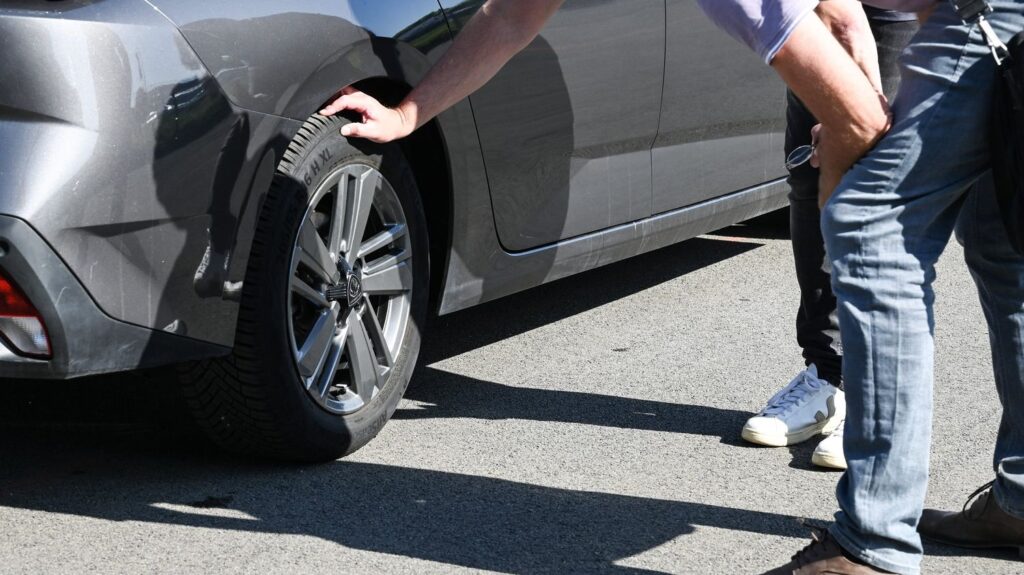
The report shows that each year, tire wear causes “significant” pollution of air, soil and water.
:quality(50)/2023/07/07/64a7df4c5fe71_placeholder-36b69ec8.png)
Published
Reading time: 2min
:quality(50)/2025/11/03/maxnewsfrfive199628-6908871209f58329772597.jpg)
It is “a toxic cocktail”judge Monday November 3 on franceinfo Stephen Kerckhove, general delegate of the Agir pour l’environnement association which publishes a report on pollution linked to the composition of the tires. This report explains that each year, in France, tire abrasion results in the release of nearly 80,000 tonnes of substances into the air, soil and water. These particles, according to the Agir pour l’environnement report, expose the entire population, particularly children, to increased risks of cancer, neurological disorders, as well as respiratory and cardiovascular diseases.
“It is a very significant and poorly evaluated pollution, in terms of quantity and ‘quality’. We analyzed six types of tires from major manufacturers’ brands and we found 1 954 different molecules”explains Stephen Kerckhove. Among them, 40% present a danger to human health or the aquatic environment.
Precisely, according to the general delegate of Agir pour l’environnement, “111 (molecules) would be toxic for aquatic environments, 112 are classified CMR, that is to say carcinogenic, mutagenic or reprotoxic by the European Chemicals Agency”. Reprotoxic means that which is toxic for reproduction. Also, 85 of them can even be “Potentially fatal if swallowed and enters airways”the report states.
“We are sounding the alert and we would like the National Environmental Safety Agency (ANSES) to carry out an investigation into these molecules”adds Stephen Kerckhove. The damage to human health, “we don’t know them”he admits, because“there is a lack of transparency, particularly from manufacturers”. “We are asking for the lifting of industrial secrecy (on the composition of tires) so that scientists can carry out investigations.”