/2025/11/04/amelie-de-montchalin-690936a348ff3486122318.jpg)
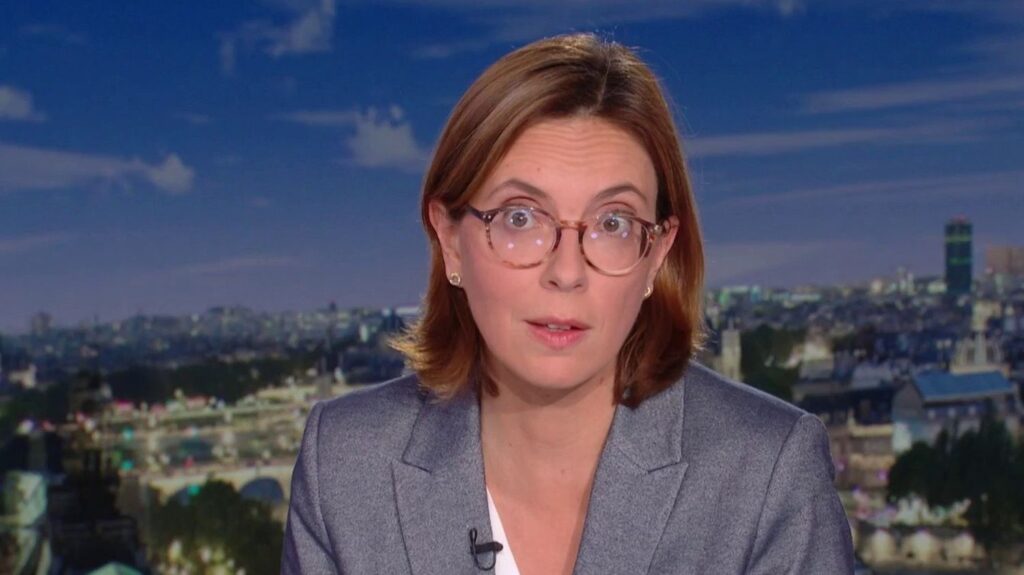
The Minister of Public Accounts Amélie de Montchalin announced on France 2’s “20 Heures” Monday evening that the government wishes to transmit the amendments voted during the examination of the revenue part to the upper house of Parliament, despite the delay in examining the revenue part of the 2026 budget.
Can the 2026 budget be voted on before the end of the year? The revenue part, which was to be debated and voted on in the National Assembly before Monday, November 3 at midnight, has fallen behind schedule. Are we heading towards a budget impasse? To talk about it, Amélie de Montchalin, the minister responsible for public accounts, is the guest of “20 Heures” on France 2.
This text corresponds to part of the transcription of the interview above. Click on the video to watch it in full.
Léa Salamé: This morning, there were still 2,500 amendments to examine in the revenue side of the budget. You were supposed to finish at midnight tonight. Will you make it? And will you be able to get this revenue side of the budget adopted?
Amélie de Montchalin: Already, tell the French that we are in an endurance race and that we have until November 23 to work on the budget before passing it to the Senate. What I can tell you this evening is that I am with parliamentarians day and night. I see the architects of compromise who represent a majority and who are not cynical and who have decided to believe that we can, before thinking about the presidential election of 2027, work for the French today. This majority is today opposed to two blocs, that of the National Rally on one side, that of the Insoumis on the other, who are betting on failure and do not want this compromise. What I can tell you, and it is an announcement, is that the Prime Minister and the entire government are committed to what is being done today as work and which is quite unprecedented, which takes its time, because we are in a situation where we have renounced 49.3, all the amendments have been voted on. The government undertakes, according to the political configurations which will allow it, to transmit them to the Senate. It’s important what I tell you, because what we’re doing is not a masquerade, it’s not theater.
Because if we say: “What’s the point? They argue, they argue, they compromise, but in the end it won’t work.”
In the end, I tell you, we gave up on 49.3. The Prime Minister is committed to giving power to parliamentarians.
Are you sure you’re giving up the 49.3? Sorry to specify, but this weekend, there were voices that were heard, particularly in your camp, for example Marc Fesneau from MoDem, who said that we could not do without 49.3…
Today, there are oppositions, there are indeed parties who want to get involved. Together, we arrive subject by subject to find compromises. Obviously, when you listen to what I call the scammers, the illusionists, the RN or LFI who vote for totally incoherent things, what they want is for it to go off the rails, for it to stop. I can tell you that we work with people who are in government, people who are not in government. I am thinking in particular of the Socialist Parties, the Ecologists, the Communists. Even today, you have had votes where this compromise was built. But it’s a step. It will continue at its own pace. And we, in the government, want to give a budget to the French because we want, before thinking about the presidential election, to think about the French.
Do you think a budget will be voted on before December 31?
Before the end of the year, that’s all my job, is for the government to put itself at the service of parliamentarians so that we can prove what we say.
A number of new taxes and duties have been voted on multinationals, on the richest. There is a new tax on unproductive wealth to be adopted last Friday. How much will it bring to the State?
This is an important question. This evening, what I can say to the French is that we, the government, have a line which is to preserve work, jobs, in short work that pays. On the one hand, we have an increase of around 3 billion euros in taxes paid by multinationals, the 400 largest companies in France. We also have a reduction of 3 billion euros which was voted for SMEs, the smallest and medium-sized enterprises. So you see that, it’s interesting, it’s already a path of compromise. For households, less than 3 billion euros were voted for and 5.5 billion euros will also be contributed by the wealthiest. This is more than François Hollande’s ISF. So it will bring in 5.5 billion euros. And these are 150,000 households, or 0.3% of French people, who will make it possible to have these 5.5 billion.
Roughly 200,000 people will pay more.
A little less than 200,000 people who will pay more.
Exactly, you hear them, the business leaders, who tell you: “We are suffocating under these new taxes, what you are doing is fiscal madness, you are killing the economy.” This is for those who say they are still staying in France; others say: “Where did he go.”
What I’m telling you is that you see, when we lower SME taxes, and it’s not me who’s doing it, it’s the MPs who decided to reduce SME taxes by 3 billion euros. When I see that the deputies agree on overtime, when I see the deputies agree on tips, when I basically see these compromises taking shape, it is not necessarily the government’s copy. But you see, step by step, the Assembly and the Senate are drawing a line. And we, our red line, our common thread with the Prime Minister, is that we must ensure that work pays, we must ensure that business leaders have confidence and can continue to create jobs. This is the battle we want to fight.
There is the budget, the finance bill and there is the Social Security bill, which arrives in the Chamber tomorrow, and there too the debates promise to be extremely tense. You heard it in our report, the Cannes University Hospital, the Toulouse University Hospital, the hospitals are not doing well, hospital professionals fear the worst austerity cure since 2010 with your Social Security bill. What do you tell them this evening?
First, I tell them that the Prime Minister said it, and I really want to confirm it this evening: the government wants to support an increase in hospital resources by 1 billion more than what was put in the initial budget. It’s 1 billion for the hospital, for autonomy, for health, and it’s in addition to what we had proposed.
1 billion more for health, for the hospital, to be very precise?
To focus on the hospital and what goes around it, in particular the issues of autonomy and aging which are linked to the hospital. And that is, I believe, an important announcement for hospital healthcare workers. There was a lot of talk about savings in the Social Security budget and there will be debates. But we somewhat forgot to talk to the French about the other choices that Minister Stéphanie Rist, that Jean-Pierre Farandou, and myself, at the request of the Prime Minister, will make. This Social Security budget is the largest chronic disease prevention plan. It is the largest plan to support mental health. That’s 4,500 recruitments in nursing homes. It is also a great support for what we call France Santé, so that all French people have a doctor near them who can welcome them when there is an emergency. Finally, for women’s retirement and birth leave, it is a support for our demographic issue of aging and support for families.
You announce a billion more for the hospital, but how to finance it? We saw the Social Security deficit for this year, 23 billion, the Court of Auditors is appalled, has it never been this big since 2012, excluding the Covid period?
And for that, you know that we have put on the table a certain number of proposals which will be debated, because what you say, I think it is the conviction of all French people. The French want to be well looked after, they want to continue to be well looked after, and so do we. But to receive good care, we need to have funding and appropriate health policies.
So you tell them you are going to pay more for your health?
No, that means that, for example, we are going to make real efforts on the price of medicines with pharmaceutical laboratories. This means that, yes, we are going to put a little more effort into mutual funds, particularly some of which have high management fees. And then, on medical deductibles.
Do you want to double them?
What the government is talking about, and here too, we are going to debate it, is that today we are the country almost in the world where the remaining dependents are the lowest. We want to remain the country where it is the weakest. But it will increase. Today, 18 million French people pay nothing. The question is do we want to expand to a little more than 18 million French people, the most modest, the most fragile? I think it’s a good social debate because in the end, to take good care of the French, it must also be well financed.