/2025/10/31/080-hl-adesdevises-2667564-1-6904a4846e198123909078.jpg)
Did a French industrial giant finance the Islamic State group? The trial of cement manufacturer Lafarge, now a subsidiary of the Swiss group Holcim, and eight former managers, employees or intermediaries for “financing a terrorist company” opens Tuesday, November 4 before the Paris Criminal Court. The company is accused of having paid several million euros to jihadist groups in Syria, between 2013 and 2014. Sums which were used to maintain the activity of its factory in Jalabiya, in the north of Syria, in the midst of the civil war, by paying passage fees, monthly donations or by obtaining supplies from these groups. Franceinfo summarizes what you need to know about this case of an unprecedented nature, the trial of which must last until December 9.
What is the company and some of its managers accused of?
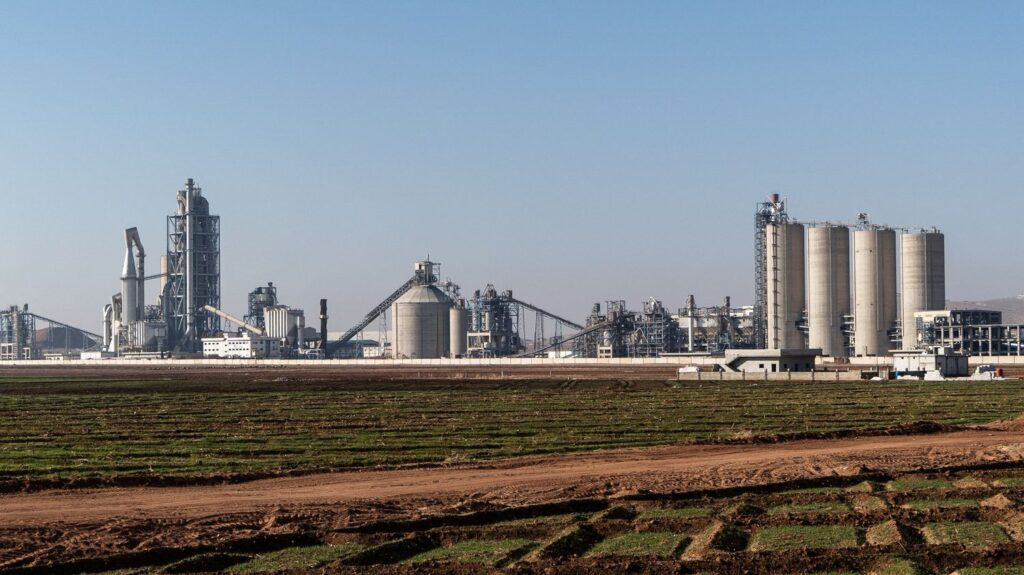
In 2008, the Lafarge group acquired the Jalabiya cement plant, located in northern Syria. The buyout, estimated at 600 million euros, made the subsidiary Lafarge Cement Syria (LCS) one of the largest foreign investments in the country. But in 2011, the repression of “Arab Spring” protests by Bashar al-Assad’s regime plunged Syria into civil war.
While other multinationals left the country in 2012, Lafarge only evacuated its foreign employees that year and maintained the activity of its Syrian employees until September 2014, the date on which the Islamic State (IS) group took control of the factory. In the meantime, Lafarge is accused of having provided several million euros to jihadist groups, such as ISIS and Jabhat al-Nusra, in the form of donations, taxes and rights of passage, in order to guarantee the free movement of workers and goods on roads controlled by jihadist groups, and to source raw materials from them.
However, the European Union had banned on June 28, 2013 any financial or commercial relations with IS. The violation of this embargo motivated the French Ministry of Economy and Finance to file a complaint in September 2016. At the same time, associations and former employees of the Syrian subsidiary of Lafarge filed another complaint, this time for financing terrorism. After more than eight years of investigation, the company and the eight defendants will have to answer for charges of financing terrorist companies and, for some, of non-compliance with international sanctions.
The investigating magistrates believe that the defendants “have, in a logic of seeking profits for the economic entity they served, or for some direct personal profit, organized, validated, facilitated or implemented a policy involving sending financing to the terrorist organizations established around the cement factory”. They also claim that the company “could have put an end to the operation of the factory at any time, particularly when its managers became aware of the financial demands of the terrorist entities”.
The group was also indicted for “complicity in crimes against humanity” in Syria and Iraq – a world first against a company. But this aspect, separated from the “terrorist enterprise financing” part in 2023, is still under investigation and will be the subject of a separate trial at the assizes.
Who are the defendants and how do they defend themselves?
Alongside the Lafarge group, absorbed in 2015 by the Swiss Holcim, eight people are appearing before the Paris criminal court, including four former senior managers: Bruno Lafont, ex-CEO of the cement manufacturer, Bruno Pescheux, former director of its Syrian subsidiary, his successor Frédéric Jolibois, and Christian Herrault, deputy general director in charge of operations. Two former employees in charge of security in Syria, as well as two Syrian intermediaries, are also on trial. One of them, subject to an international arrest warrant, will be absent.
Faced with the accusations, the Lafarge group justified itself in 2016, in the columns of World : “The situation in Syria was very complicated and evolving in 2013-2014. Not all of the people who worked there can be reached. It is difficult for us to react to emails without having checked everything, the factory has been closed since September 2014.” This defense, considered unconvincing, contrasted with explicit email exchanges between the managers and their intermediaries consulted by The World.
After the merger with Holcim, the new entity took care to assert its lack of link with facts prior to 2015. An internal investigation was nevertheless opened, entrusted to two French and American firms, and concluded, in 2017, that “violations of Lafarge’s code of business conduct”. In October 2022, Lafarge SA pleaded guilty in the United States to having paid the IS group and Jabhat Al-Nusra nearly $6 million, and agreed to pay a financial penalty of $778 million.
This decision is denounced by several French defendants, in particular the former CEO Bruno Lafont, who denies having been informed of the payments to terrorist groups. Contacted by AFP, his lawyers consider that this guilty plea, on which the French investigating judges partly rely in their order, “is a blatant attack on the presumption of innocence, which throws former Lafarge executives into pasture” and had “for the purpose of preserving the economic interests of a large group”.
Who are the civil parties and what are they demanding?
In total, 241 civil parties were formed in this case, according to an AFP count taken on October 31. Among them, we find eleven associations, including Sherpa and the European Center for Constitutional and Human Rights (ECCHR), at the origin of the complaint filed in 2016 alongside eleven former Syrian employees, who were also civil parties. Then, among others, the Human Rights League and around twenty additional employees were added.
“More than ten years after the events, former Syrian employees will finally be able to testify to what they endured: checkpoint crossings, kidnappings and the permanent threat hovering over their lives”emphasize Anna’s Safe, two Sharp. “Lafarge put my life and that of my colleagues in danger simply for its own gain”said Mohammad, a former Lafarge employee in Syria and plaintiff in the case, quoted by Sherpa in a press release in 2022. “Companies should not be able to use their power to escape responsibility”adds the ex-employee, who claims that “we will continue to demand the justice we deserve”.
Lafarge faces fines of up to 1.125 million euros for financing terrorism. For violation of the embargo imposed by the EU, the fine incurred is significantly heavier, going up to 10 times the amount of the offense which will ultimately be retained by the courts.
“It is essential that the investigation continues into the other offenses”warns, however Sherpawhich reminds us that “Lafarge is the first company in the world to be indicted for complicity in crimes against humanity”. “As the Court of Cassation recalled in this case, it is the multiplication of acts of complicity which allows the crime against humanity, the ‘the most serious of crimes'”underlines the association, for which “these acts of complicity cannot therefore go unpunished”.