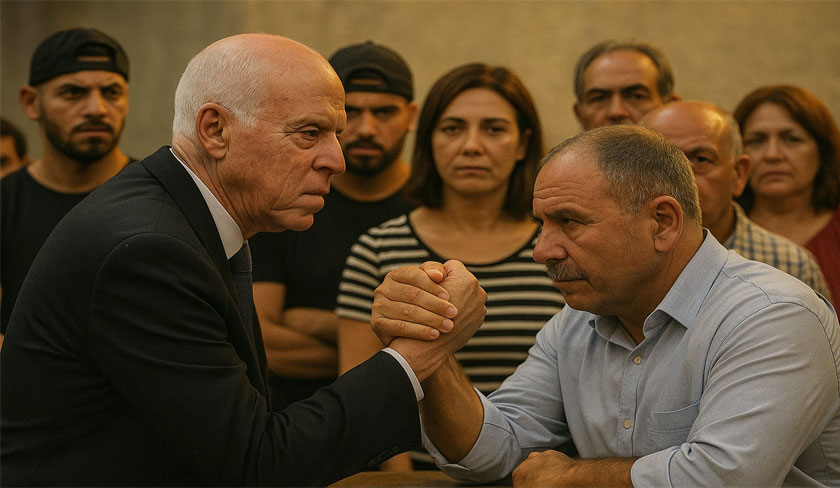
The government puts the UGTT back in its crosshairs. Coordinated attacks, media smears, thinly veiled threats: the demonization machine is running at full speed. Tension has rarely been so strong since Kaïs Saïed came to power.
For a week, the signals have been accumulating. The president’s zealous supporters — the famous We stood up — invaded social networks to accuse the UGTT of treason, corruption and “indecent privileges”.
The arguments are always the same: bankers and trade unionists would be too well paid to dare to strike, and the central office, they say, would sabotage “the national effort”.
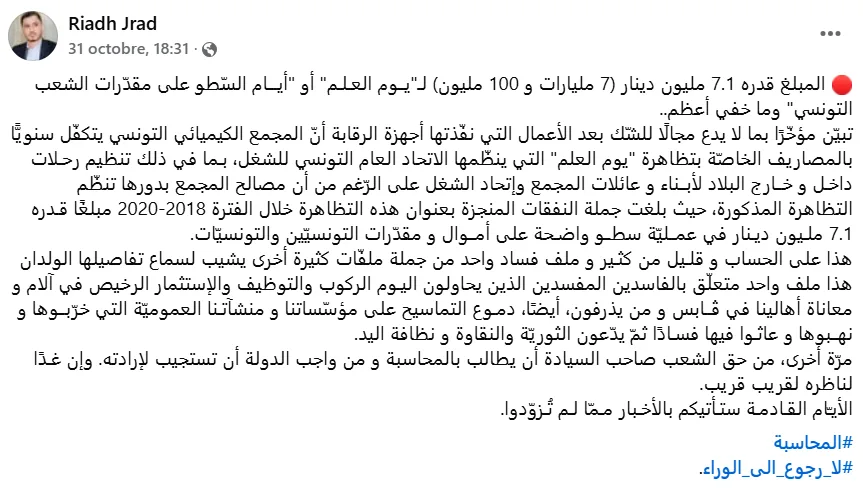
The campaign found its leader: Riadh Jrad, a notorious propagandist, close to the palace of Carthage and a recurring figure on the Attessia plateaus. His words are still echoed by hundreds of We stood up.
On October 31, on Facebook, he published an inflammatory post accusing the UGTT of having received “ 7.1 million dinars from the Tunisian chemical group » to finance the Day of Knowledge. He ends in a threatening tone: “ This is just one file among others… the next few days will bring you news that you did not expect. »
Three days later, yesterday Monday November 3, he put the cover back on television, brandishing documents and an angry tone, without ever citing a source or legal framework. The accusation does not need to be proven: it simply needs to be dirty.
The climate of tension
This media sequence comes the day after a total strike in the banking and financial sector.
On November 3, banks, insurance companies, leasing companies and stock brokers ceased all activity. At Mohamed Ali Square, in front of the historic headquarters of the power plant, Noureddine Taboubi greeted “union unity” and denounced “smear campaigns and restrictions on union work”.
The regime has not digested this success. The strong mobilization reminded us, once again, that the UGTT remains a living counter-power, capable of blocking the country in a day.
And in a context of social crisis and regional anger, this demonstration was enough to trigger the nervousness of those in power.
But another subject ignited yesterday: the dizzying growth of the budget of the Presidency of the Republic between 2020 and 2026. The figure circulated everywhere, fueling discussions on social networks and awakening the anger of Tunisians in the face of the austerity imposed on them. This figure increased from 144 million dinars in 2020 to 229.7 million dinars in 2026.
And it is precisely at this moment that Riadh Jrad resurfaces on the Attessia set. By crying scandal and designating the UGTT as the new “enemy of the people”, he offers the regime an ideal diversion.
By turning his eyes away from the palace of Carthage towards the union center, he transformed economic anger into a union witch hunt. A classic maneuver: to forget the palace figures, Gabès and purchasing power, by pointing the finger at supposed corruption elsewhere.
The shift in diet
Until recently, Carthage seemed to want to avoid direct confrontation with the powerhouse. We wrote it last Thursday. But the situation changed in a few days.
The Gabès demonstrations, ecological anger, political trials, the deterioration of purchasing power, the suspensions of NGOs: so many fronts that the regime is no longer able to contain.
To divert attention, an old tactic resurfaces: creating an enemy within. This time, the UGTT plays the role of the convenient culprit, the one who is accused of all evils to make people forget the essentials.
What yesterday was a matter of careful calculation today becomes an open offensive. Power no longer seeks to avoid confrontation, it methodically provokes it.
At the origins of arm wrestling
To understand the current tension, we have to go back to the summer.
On August 11, the Minister of Social Affairs, Issam Lahmar, suddenly suspended all social negotiations. A brutal decision, which disrupts a social balance maintained since Bourguiba.
The union reaction was immediate: three days of general strike in public transport, followed 100%. The country at a standstill, the government irritated.
On August 7, demonstrators close to the regime gathered in front of the headquarters of the power plant to accuse it of corruption. The presidency endorses the action and publishes a video during the night.
Four days later, the UGTT responded. During the meeting of the Administrative Commission, slogans burst out against the president with a most virulent tone. The tone is set: the time is no longer for conciliation.
Then comes August 21. Nearly 3,500 demonstrators march between Place Mohamed Ali and Avenue Bourguiba, breathing new life into the union protest. And while the UGTT shouts, Kaïs Saïed walks.
The president crosses Tunis for hours, from the souks to the hospitals, as if to reaffirm his control over the street. A symbolic, almost childish, response to union mobilization: the head of state wants to show that he too occupies the ground.
Last week, the regime ratified the breakdown in social dialogue by announcing, in the 2026 finance law, salary increases in both the public and private sectors. A first in the recent history of the country: until then, these adjustments were the result of tripartite negotiations between the government, the UGTT and Utica, where much more than figures were discussed. Social achievements, logistics, benefits and all subjects of the world of work are discussed in these negotiations. By deciding alone, the government definitively turns the page on social partnership and confirms its choice of assumed economic authoritarianism.
The announced showdown
Since then, the tension has never really eased.
The fall was marked by the two major demonstrations in Gabès, on October 21 and 31, which brought together between 40,000 and 45,000 people according to local estimates. It is the largest ecological mobilization in the country’s history, born from the anger of a population exasperated by chronic pollution from the Tunisian Chemical Group (GCT).
Officially, the UGTT was not an organizer. Unofficially, no one doubts it: such discipline in slogans, such logistics in processions and such mobilization of regional structures can only come from the union center.
His mark was everywhere, in the rigor of the organization as well as in the slogans: “Dignified life for Gabès”, “No to poisoning”, “Environmental justice for the South”.
And this hand of the UGTT, even discreet, was enough to make those in power shudder. Because through Gabès, an entire economic and political model is called into question: that of a State which exploits without repairing, which pollutes without accountability.
The regime saw in these massive marches more than an environmental demand: a demonstration of social force capable of transforming into an uprising.
And if, for a time, Carthage seemed to be procrastinating, it has now changed course. The UGTT is no longer just a social actor, it is now a political target.
Power strives to weaken public opinion, to fuel suspicion, to wear down public confidence. And as always, television and social media do the dirty work for him.
Power without counterbalance
Tunisian history has already proven it: no president has ever won against the UGTT.
Neither Bourguiba in 1978, nor Ben Ali in 1994, nor even the troika governments in 2013 managed to bend it. In each confrontation, the union center emerged stronger, more rooted, more legitimate.
But this time, the context is different. Kaïs Saïed advances alone, without parties, without dialogue, without institutional safeguards. He governs by fear, by staging, by designating scapegoats.
The UGTT is today the last organized force capable of resisting it, and that is precisely why it is disturbing.
The logic is implacable: the more the regime isolates itself, the more it attacks. After judges, journalists and lawyers, the trade union center becomes the new target. Not because it has changed, but because it continues to exist where all the other counter-powers have remained silent.
What is at stake today goes beyond just the union dispute. It is a battle for the democratic breathing of the country.
The government wants to silence the streets. The UGTT simply wants to keep it alive.
And in this breathless Tunisia, a truth imposes itself: as long as the power station resists, power will never be completely absolute.
Raouf Ben Hedi