/2025/11/06/broadp3nku7-690c5c1296d5d898747683.jpg)
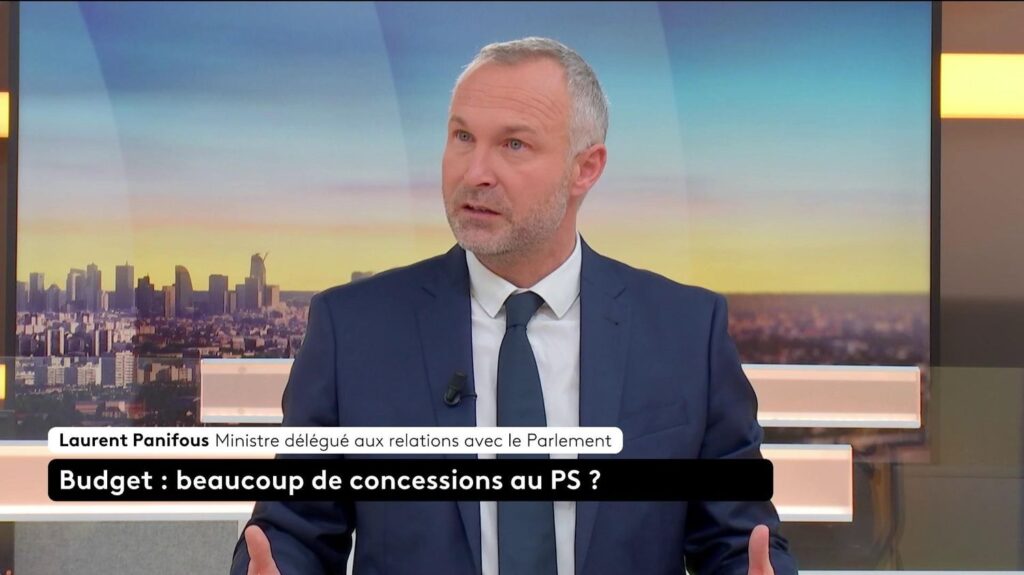
Laurent Panifous, Minister Delegate in charge of Relations with Parliament, was Franceinfo’s political guest on Thursday November 6. He returned to the tragedy that occurred the day before on the island of Oléron, before discussing the fragile balances of the National Assembly and the search for compromise led by the government in the current budgetary discussions.
This text corresponds to the transcription of part of the interview above. Click on the video to watch the interview in full.
Alix Bouilhaguet: We obviously start with this tragedy that occurred on November 5 on the island of Oléron. An individual deliberately hit five people. Two of them are now in serious condition. Do you have any additional details regarding this tragic event?
Laurent Panifous: I cannot say any details at the moment, but let me first spare a thought for the victims and their loved ones, as well as a word of gratitude for those who protect us on a daily basis: the rescue and security forces, who took care of the injured. The Minister of the Interior is of course following the situation very closely. An investigation is underway, and it is difficult to say more at this stage. But it was a real tragedy that we experienced on this island.
Alix Bouilhaguet: The anti-terrorist prosecution is present on site under observation, but it has not been contacted at this stage. This means that even if the individual shouted “God is great” at the time of his arrest, this is not enough, for the moment, to qualify the facts as a terrorist attack.
Laurent Panifous: Indeed, not yet. As you said, the anti-terrorism unit is on site as an observer. We must wait until we have more elements to be able to legally qualify the facts.
Alix Bouilhaguet: Yesterday, during questions to the government, RN deputy Sébastien Chenu challenged the executive by evoking a possible Islamist threat. Did he go too quickly in your opinion?
Laurent Panifous: Yes, I think so. You have to be careful. The facts are serious, and this type of event must not be used for political purposes. Let’s wait for justice to shed light on what happened. The facts are too serious to rush to hasty conclusions.
Alix Bouilhaguet: A final word on this matter. On November 5, it was Marie-Pierre Vedrenne, Minister Delegate to the Minister of the Interior, who responded to Sébastien Chenu, while Laurent Nuñez went to Oléron. Some found it surprising that the Prime Minister did not respond to the MP himself. What do you think?
Laurent Panifous: I do not share this analysis. It is entirely logical that it is the minister delegated to the Minister of the Interior who answers these types of questions. It’s customary.
Alix Bouilhaguet: Even in the case of a tragedy of such seriousness?
Laurent Panifous: Yes, even in this case. Once again, the priority is to understand what really happened. We sometimes tend to move too quickly in analyzing causes and consequences. The present time is that of justice and care for victims and their loved ones. The political time will come later, when justice has established the facts and we can draw the consequences.
Alix Bouilhaguet: You are Minister of Relations with Parliament, a position that some describe as “mission impossible” as the National Assembly is today fragmented. We’ll come back to the budget calendar, but first: what is your method? Do you meet the MPs one by one? Do these exchanges take place in the corridors of the Assembly, or even at the famous refreshment bar?
Laurent Panifous: No, this does not happen in the National Assembly refreshment bar, but rather during individual interviews with deputies. All have their legitimacy, without exception. I am speaking in particular to those who want stability and want to allow the country to have a budget before the end of the year.
It will not have escaped your notice that part of the hemicycle is seeking, in a certain way, to cause chaos, the fall of the government, or even a dissolution to lead to early elections. But there is also another majority, more silent perhaps, which wants stability and parliamentary work. My role, with others, consists of bringing together deputies of different sensibilities to promote compromise. This is what I was already doing when I chaired the Liot group: bringing elected officials with diverse positions into dialogue to reach a common agreement.
Alix Bouilhaguet: The Prime Minister seems to grant a lot of concessions to the socialists: renunciation of 49.3, suspension of the pension reform, abandonment of the freezing of pensions and social minimums… Can we speak of a formal agreement between the government and the Socialist Party?
Laurent Panifous: No, there is no written agreement between the socialists and the Prime Minister. It is a constant search for compromise, point by point. This is a new method, adopted by the Prime Minister: negotiation in broad daylight, amendment after amendment, in complete transparency.
We regularly see him come to the Assembly bench to arbitrate moments of tension himself, live. It is, in my eyes, a great moment of parliamentary democracy, perhaps confusing for some MPs, but salutary. We are witnessing something new: the construction of the compromise live, in front of the French and their representatives. We are no longer in a logic of fixed blocks: left against right, majority against opposition but in an approach of responsibility and stability. The government has taken the first steps towards this compromise, and it is now up to other political forces, on the right and on the left, to do the same.
This text corresponds to the transcription of part of the interview above. Click on the video to watch the interview in full.