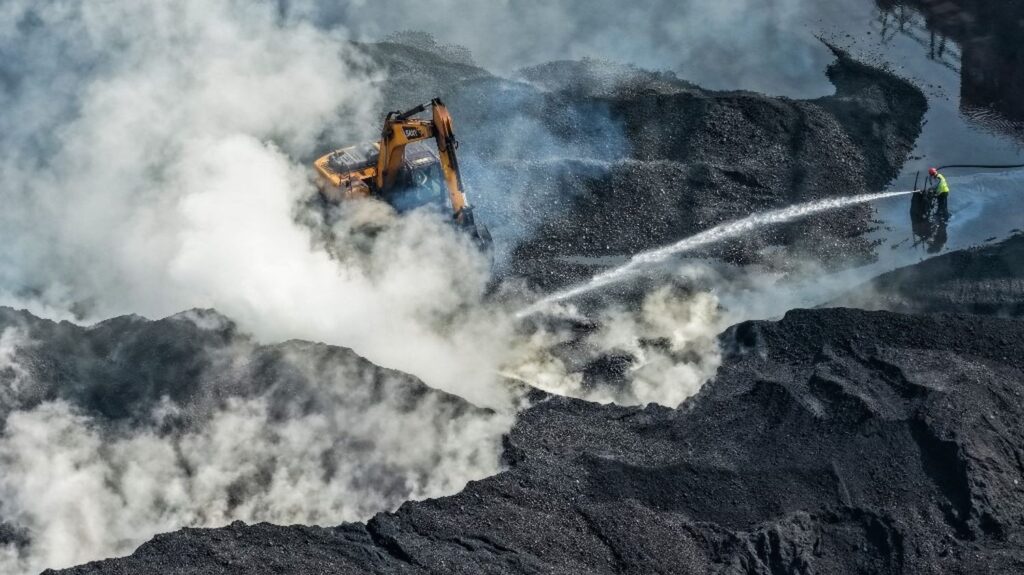
CO2, carbon dioxide, is the main greenhouse gas causing global warming. The international organization, which brings together rich countries, highlights the situation of “OECD partner” countries, such as China, India and Saudi Arabia.
:quality(50)/2023/07/06/64a68815cd1a7_placeholder-36b69ec8.png)
Published
Reading time: 3min
:quality(50)/2025/11/06/091-i1761919382159-690c73da8899a479255512.jpg)
Will this report be the subject of discussions at COP30? Economic growth, particularly in emerging countries, is the main factor responsible for the rise in global greenhouse gas emissions, according to a OECD report published Thursday November 6. “Economic growth drives emissions in OECD partner countries”writes in its “Climate Action Observer” 2025 the international organization which brings together rich countries.
Among these “partner countries“there are large emerging economies whose emissions continue to grow, driving those of the whole world: China, India, Saudi Arabia among others. And countries where they are falling slightly: Brazil, Indonesia and South Africa. In these partner countries, “population growth and strong economic growth outweigh improvements in energy efficiency”explained the OECD.
Reducing emissions is the key to the fight against global warming, which appears increasingly compromised. Each additional tenth of a degree brings its share of disruptions to biodiversity, the water cycle and natural disasters.
The authors of the report calculate that between 2015 and 2023 in these countries, where emissions increased by 19.3% over this period, the growth of gross domestic product (GDP) alone is responsible for an increase in emissions of 29.5%, far ahead of that of the population (+5.6%) and the greenhouse gas intensity of energy production (+3.3%), while improving energy efficiency limits emissions. (-19.1%). In these countries, “Worryingly, despite record deployment of renewables, the greenhouse gas intensity of energy production has increased, reflecting a resurgence of coal-fired thermal power”notes the OECD. But coal has all the makings of a climate bomb: it is the energy source that emits the most carbon dioxide (CO2), the main greenhouse gas.
OECD countries, with more anciently industrialized economies, “have reduced their emissions by improving energy efficiency and switching to cleaner energies, while continuing their economic and demographic growth”according to the report. From 2015 to 2023, their emissions fell by 11.3%.
Since the 19th century, the average temperature of the Earth warmed by 1.3°C. Scientists have established with certainty that this increase is due to human activities, which consume fossil fuels (coal, oil and gas). This warming, unprecedented in its speed, threatens the future of our societies and biodiversity. But solutions – renewable energies, sobriety, reduced meat consumption – exist. Discover our answers to your questions on the climate crisis.