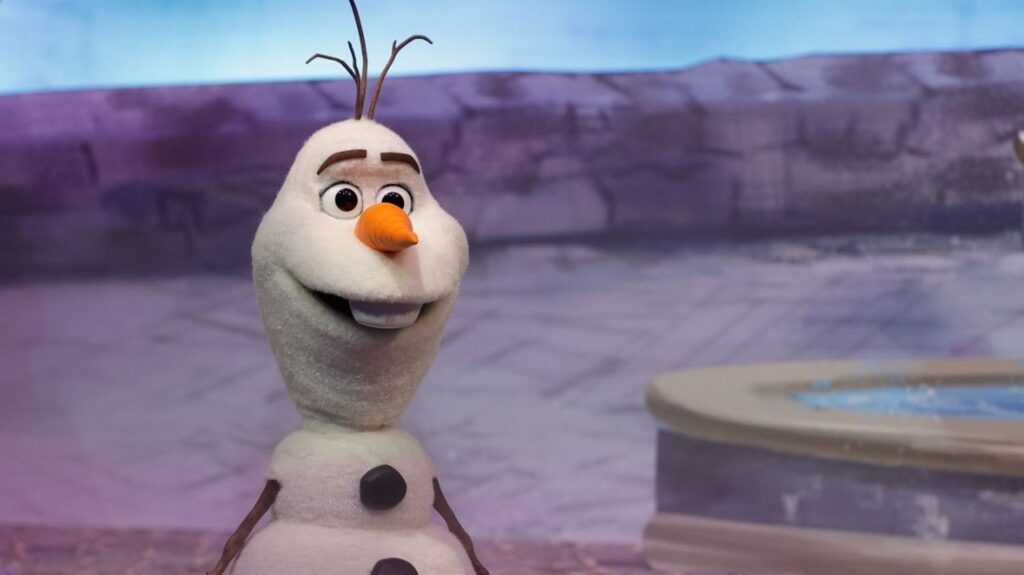
The little snowman in the new Disneyland Paris extension is not just an adorable gadget: it is the showcase of a new generation of robots capable of learning to move like real characters. Behind the scenes, Disney now mixes robotics, AI and the art of movement.

Published
Reading time: 3min
:quality(50)/2025/12/01/000-862t4q8-692d82191eff9700870851.jpg)
Monday November 24. The journalists laugh in front of Olaf, the hero of Frozen, who strolls on stage for the presentation of his future extension Frozen World. We first think of an irresistibly cute gadget: a snowman with hesitant steps, who follows you with his gaze and blinks as if he were going to speak to you. You can even remove your carrot nose.
But behind this perfectly calibrated clumsiness lies one of Disney’s biggest technological shifts since the first animatronics of the 1960s. And a change in method that says a lot about the way the entertainment industry already visualizes the future.
The multinational has also published a 35-minute video to present its robots. Head to Walt Disney Imagineeringin California. There, engineers and computer scientists design the attractions and the park robots. They say: Disney is no longer just looking to build robots that work, but robots that feel something, or at least that give the illusion of it. Because Olaf, like the humanoid prototypes behind the scenes, does not just move from point A to point B. He walks “like Olaf”. The little sway of the torso, the head that moves slightly to the side, the feet that are never sure of themselves: all these micro-gestures tell an emotion. They must give the sensation that this little being does not completely control his body – and this is precisely what makes the robot touching.
To achieve this, the teams work not to reproduce a perfect movement, but to create a controlled imprecision, an expressive approach that is more reminiscent of an animated character than a robot. And to achieve this, they use the methods that are revolutionizing robotics today: reinforcement learning. This technique consists of letting a robot try, make mistakes, start again, and improve thanks to the feedback it receives. Like a child learning to walk.
And to achieve this, Imagineering no longer works alone. In the video, we see Jensen Huang, CEO of Nvidia, the company that gave artificial intelligence its current power. Nvidia is developing certain crucial parts of these robots alongside Disney. AI is no longer a gadget: it shapes the gestures, personality and physical presence of these mechanical creatures.
What is at stake with Olaf is therefore not just an engineering feat or a marketing stunt. It’s a new way of imagining the character: no longer as a puppet or a costume, but as an artificial actor, trained to become credible. The extension will open in Marne-La-Vallée on March 29, 2026. Cost of its construction: $2 billion