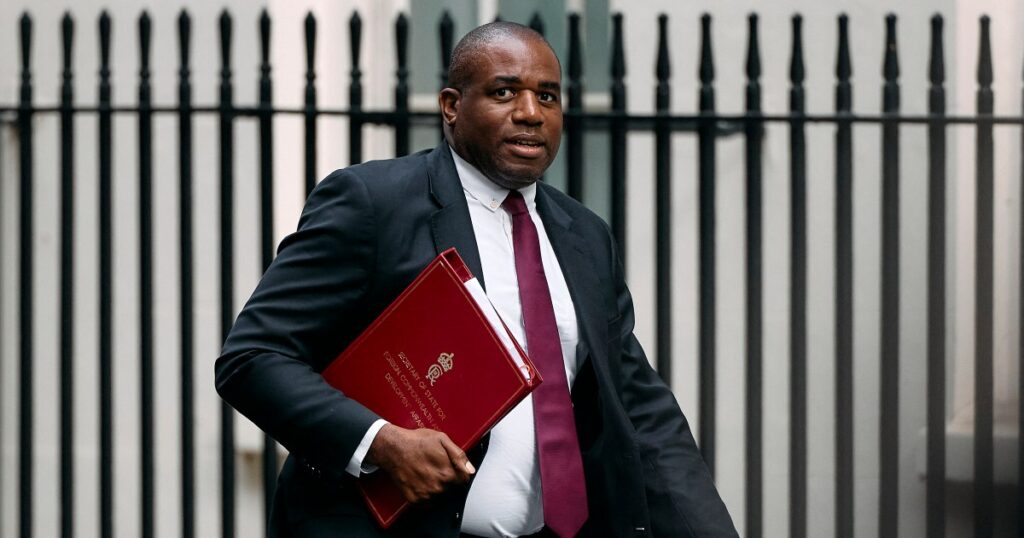
The United Kingdom’s justice secretary, David Lammy, is limiting people’s right to a trial by jury in England and Wales. Under proposals he outlined in parliament on Tuesday, only defendants accused of rape, murder or manslaughter, or cases meeting a defined “public-interest” test, will undergo a jury trial.
Reforms to the justice system include creating a new tier of “swift courts” as part of a plan to tackle unprecedented delays in the court system. New jury-free courts will take on many of the cases normally heard by juries at Crown Courts, which cover serious crimes.
Recommended Stories
list of 4 itemsend of list
The upshot is that jury trials for defendants facing relatively short custodial sentences – those of up to three years – will be scrapped in England and Wales. The reforms will not extend to Scotland, which has its own legal system, or Northern Ireland.
Earlier this year, the Ministry of Justice reported that more than 78,000 Crown Court cases remain unresolved, a record number. Eliminating the jury aspect of a trial saves about 20 percent of the time of a trial, the government claims.
What is the government proposing?
Under the reforms announced on Tuesday, criminal cases which carry sentences of up to three years, as well as complex fraud and financial cases, will be tried without juries. Serious offences, including rape, murder and manslaughter, will remain subject to jury trial.
Also under the reforms, the government will set aside 550 million pounds ($726m) for victim support services over the next three years. This will fund support for survivors and witnesses as they move through the justice system, counselling and guidance.
A Justice Ministry memo, which was circulated around Whitehall last week, had seemed to suggest Lammy would go further than he has announced by allowing jury trials for “public interest” cases with potential prison sentences of over five years only.
However, it is understood that following backlash from members of the Cabinet and legal figures, he has watered down his planned reforms.
Regardless, they represent a change from Lammy’s views in the past. In a social media post five years ago, he wrote, “Trials are a fundamental part of our democratic settlement. Criminal trials without juries are a bad idea.”
The shadow justice secretary, Robert Jenrick, accused Lammy of “scrapping the institution he once lauded”.
Why is Lammy announcing these changes now?
The reforms follow the results of a review of criminal courts by former judge Sir Brian Leveson in July. The government commissioned that review because of a significant backlog of criminal cases which had developed.
Justice Ministry figures show that the open criminal caseload was 78,329 at the end of June, 10 percent higher than the year before. The median length of cases has also increased by 10 percent – from 153 to 168 days – since 2024.
This backlog was caused primarily by two things: delays backed up from the COVID-19 pandemic, and years of underinvestment in the courts.
Leveson advised the government to end jury trials for some serious offences, which could be conducted instead by one judge or with two sitting magistrates without compromising “the right to a fair trial”.
Lammy had described the backlog as a “courts emergency” and warned that the backlog could rise to 100,000 by 2028 if it was not addressed.
Announcing his criminal court reform in the Commons, he said, “I will create new swift courts within the crown court with a judge alone deciding verdicts in trial of either way cases with a likely sentence of three years or less as Sir Brian (Leveson) recommends.”
What are the criticisms of these proposals?
The right of defendants to a trial by jury has long been a central part of the English justice system.
In advance of Lammy’s announcement, Mark Evans, president of the Law Society of England and Wales, which represents thousands of solicitors, told The Guardian newspaper that the proposals were an “extreme measure” that go “far beyond” Leveson’s recommendations.
“This is a fundamental change to how our criminal justice system operates and it goes too far. Our society’s concept of justice rests heavily on lay participation in determining a person’s guilt or innocence,” he said. “Lay participation” refers to people who are not legally trained and pertains to the right to a trial by a jury of one’s peers.
Riel Karmy-Jones, a criminal solicitor, told the BBC that the new proposals would not fix the backlog, which she blamed on decades of underfunding in the UK’s legal system.
She added that introducing an “untested layer of complexity” by removing juries would undermine the justice system.
Following the announcement in parliament, Abigail Ashford, a solicitor advocate, told the BBC: “Judge-only trials risk deepening existing inequalities and eroding confidence among communities who already feel marginalised.
“In complex or sensitive cases, removing the community from assessing credibility and fairness undermines trust in a way that cannot be compensated for by concentrating decisions in the hands of a single judge.”
A survey of Criminal Bar Association members found 88.5 percent are opposed to the creation of new “swift courts”.
What is the English history of jury trials?
The concept behind jury trials can be traced to the Magna Carta of 1215, which laid the foundations for parliamentary power. It stated that no free man could be punished “except by the lawful judgment of his peers or by the law of the land”.
While this clause did not immediately lead to the establishment of juries as they are today, it cemented the idea that state power should be constrained and that local communities – the general populace, rather than just those with legal training – should play a role in trials.
By the end of the English Civil War around 1660, the independence of juries had become a key safeguard against arbitrary rule. The Bushel’s Case of 1670 cemented this by ruling that jurors could not be punished for their verdicts, establishing the principle of jury autonomy.
The English Bill of Rights in 1689 further entrenched the right of defendants to trial by jury, particularly in criminal matters, as a safeguard against interference or abuses by the King. Juries became symbols of both community participation and protection from state overreach.
As the British Empire expanded, the jury system travelled with it, influencing judicial systems in the United States, Canada, Australia, India and parts of Africa and the Caribbean. As such, the British model remains one of the most influential templates for due process around the world.
Have any other countries scrapped jury trials?
In 1941, the Vichy regime under World War II German occupation in France replaced traditional juries with cours d’assises, courts composed mainly of judges. That system has been largely retained since then. Advocates claim it produces predictable verdicts, but critics say it has weakened the public role in administering justice.
Some parts of the former British Empire have retreated from traditional jury trials since their introduction by the British.
India abolished virtually all jury-led trials for criminal cases following a notorious murder trial in 1959, during which intense media pressure and perceived jury bias led to the controversial acquittal of Kawas Manekshaw Nanavati.
Singapore phased out juries between the 1960s and 1970s, arguing that a small, multilingual population made representative juries unreliable. Officials also claimed that complex commercial cases were too much for untrained people on juries to take on and required specialist judges.
Malaysia followed a similar path, abolishing jury trials in 1995. Officials pointed to the persistent difficulty of “empanelling” truly impartial jurors – a process that involves identifying, selecting and formally appointing citizens to hear a case.