Numerous tests and trials of humanoid robots have been carried out in recent months. China and the United States are engaged in a frenzied competition to see who will produce the most impressive robot. But France is not left out. Illustration in the industry.
:quality(50)/2023/07/07/64a7df4c5fe71_placeholder-36b69ec8.png)
Published
Reading time: 4min
:quality(50)/2025/12/03/000-36t43ay-692fe3999e855657068305.jpg)
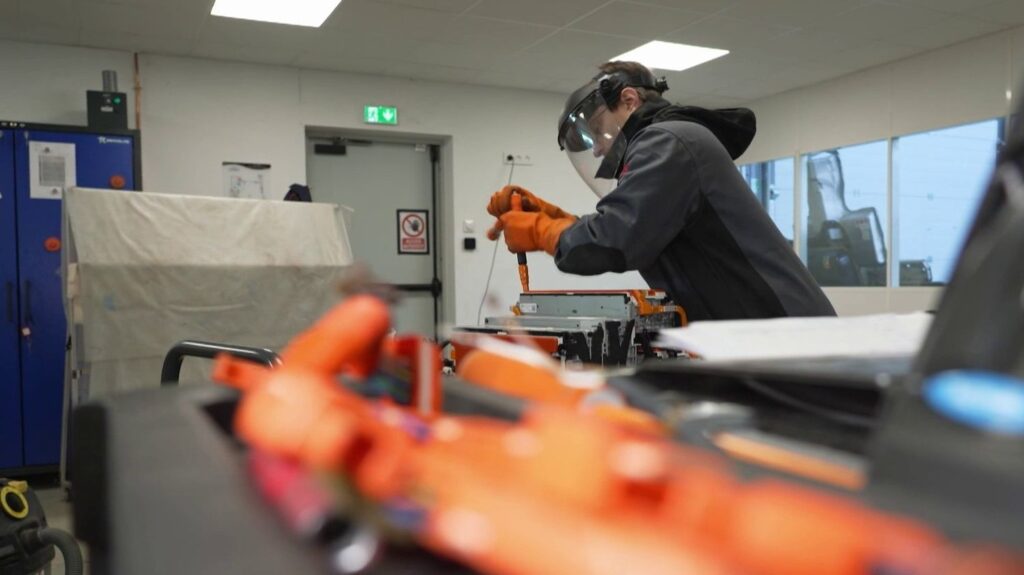
In Marcoule, right on the banks of the Rhône, lies one of the cradles of French nuclear power, the Orano Melox factory, which enriches nuclear fuel. Since October, this factory has had a new employee, a curious little alloy character, 1.35 meters tall. “Hello, my name is Hoxohe introduces himself. I am a humanoid robot and I am taking my first steps in nuclear power.”
Hoxo walks through the building dedicated to training and team training with a rather sonorous step. “We put shoes on him to limit the noise throughout the building for the well-being of the people who work here”points out an amused employee, who points out that Hoxo wears size 34.
Hoxo is not there to embody a performance for science fiction fans, there is the idea of integrating it into daily work, explains Pierre Simonnet, performance and quality director at the Orano Melox factory. “The big added value of a humanoid is that it will integrate into an environment, we do not have to adapt the environment. And given its versatility, it will be able to adapt to several environments and carry out several tasks with different vocations”.
Concretely, Hoxo will be able to carry tools and light loads or assist operators, but there is no question of replacing human beings, insists Pierre Simonnet: “All of the tasks that he is asked to do today are only assistance tasks to help people in the field carry out their activities”.
“No, it’s not Hoxo who’s going to steal my job tomorrow. Hoxo is there to facilitate our operations, to provide assistance with all the gestures that are repetitive in our installations.”
Pierre Simonnet, performance and quality director at the Orano Melox factoryat franceinfo
Hoxo is actually on trial until the end of February. Orano will then decide whether or not to integrate the factory, because this type of robot is particularly complicated to develop, explains Alexandre Embry, director responsible for the robotics department of Capgemini which develops the system’s AI. “There, we have the most complex shape that we can imagine on a robot, the humanoid form. For example, the two hands are two robots, so you have three robots. There is navigation which is done by walking. You have to understand walking and coordination with vision and dexterity.” Hoxo is a Chinese-made robot whose software is therefore developed by Capgemini. The car manufacturer Renault is also testing an industrial humanoid robot, this time developed by the French exoskeleton manufacturer Wandercraft.
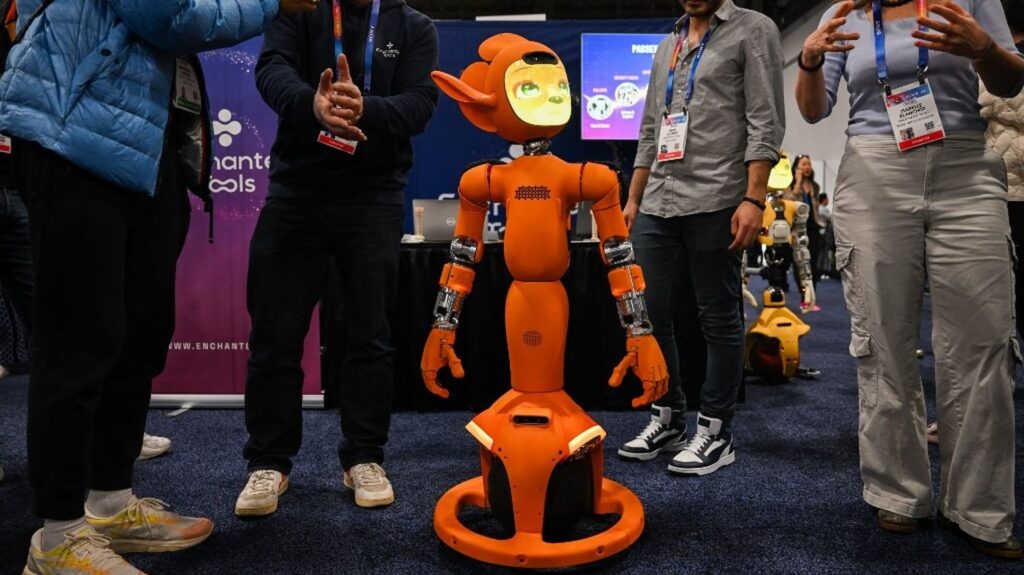
Come to the east of Paris where once a month, the startup Enchanted Tools opens its bar to spend some time with its robots, the Mirokai. They are equipped with hands, move on a sort of large ball and look like cartoon characters with two long elf ears. They are already ready and on sale for around 15,000 euros each. “Miroki is 1.26 tall meter and has 26 enginesdescribes Jérome Monceau, co-founder of Enchanted Tools. This character was designed to help in social contexts. We will find them in spaces like hospitals, retirement homes, hotels, restaurants and a whole bunch of places where robotics can help.”
Jérôme Monceaux participated in the Aldebaran adventure, French pioneer of the humanoid robot with Nao and Pepper in the 2010s, but liquidated this year. Yet for him, French tech can still align. “Aldebaran, around 40,000 to 45,000 robots were produced in total, he emphasizes. This is more than all other robots produced in China this year.”
“Let’s be proud of the technology that we are able to produce in France. We don’t just make baguettes. We make great tech. We make robots and we have 20 years of experience.”
Jérome Monceaux, co-founder of Enchanted Toolsat franceinfo
“Robots that do kung-fu in a hospital aren’t of much use”quips Jérôme Monceaux. The problem in France and Europe, he explains, is the lack of financial power and large investment funds, and also local clients to support the development of technologies.