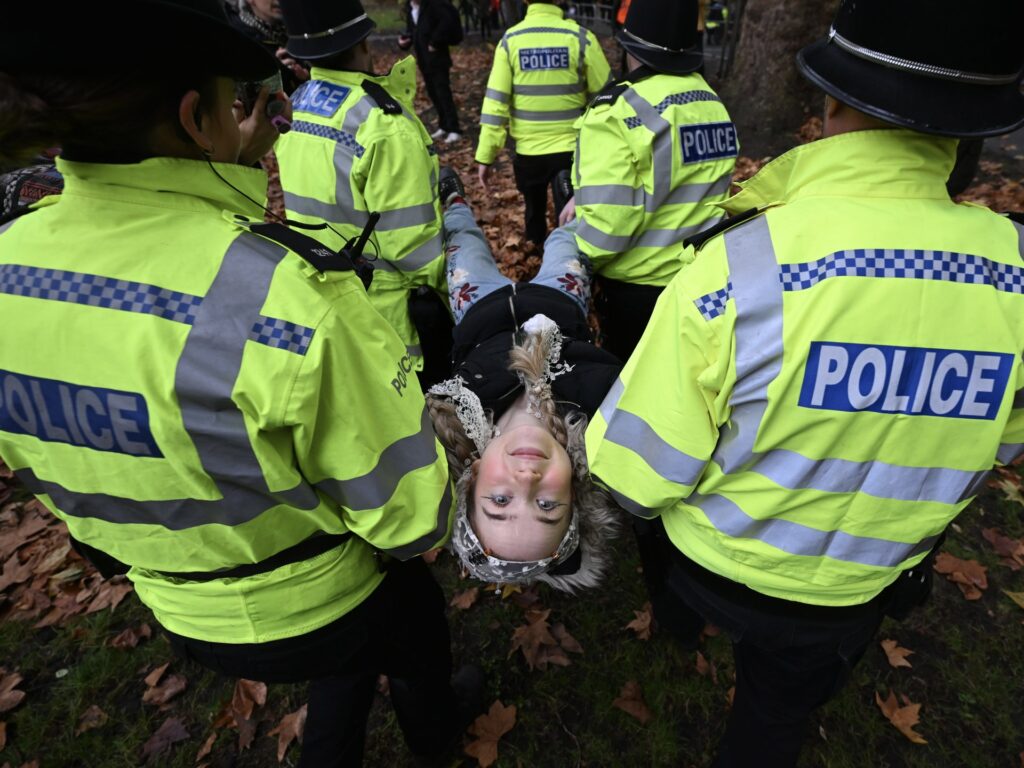
Six prisoners currently on remand and linked to the banned group Palestine Action have gone on hunger strike, prompting warnings from hundreds of United Kingdom healthcare professionals that they face an immediate risk to their lives.
The prisoners are accused of involvement in break-ins at a UK factory operated by Israel’s largest weapons manufacturer, Elbit, near Bristol and a Royal Air Force base in Oxfordshire last year, during which two military planes were spray-painted.
Recommended Stories
list of 4 itemsend of list
All six individuals deny the charges, which relate to criminal damage and unauthorised entry. Some have been held in custody for more than a year while awaiting trial.
Two of the hunger strikers were hospitalised last week, as family members raised concerns about prison conditions and a lack of government action.
So why are the six prisoners on hunger strike?
What are their demands?
The hunger strikers have five key demands: immediate bail, the right to a fair trial (which they say would include the release of documents related to “the ongoing witch-hunt of activists and campaigners”), ending censorship of their communications, “de-proscribing” Palestine Action, which is classed as a ‘terrorist’ group, and the shutting down of Elbit Systems, the Israel-based defence manufacturer with several UK factories.
The protesters have also called for an end to their alleged censorship in prison, accusing authorities of withholding mail, calls and books.
Looking ahead, the six prisoners are expected to be held for more than one year until their trial dates, well beyond the UK’s six-month pre-trial detention limit.
What have they been charged with?
The prisoners on hunger strike, aged between 20 and 31, are: Qesser Zuhrah, Amu Gib, Heba Muraisi, Teuta Hoxha and Kamran Ahmed. Lewie Chiaramello is on a partial strike, refusing food every other day as he is diabetic.
They are being held across five prisons for their alleged involvement in break-ins at the UK subsidiary of Elbit Systems in Filton near Bristol, where equipment was reportedly damaged, and at a Royal Air Force base in Oxfordshire, where two military aircraft were sprayed with red paint.
The prisoners deny the charges against them, which include burglary and violent disorder.
Palestine Action was branded a ‘terror’ group in July, a label that applies to groups such as ISIL (ISIS). More than 1,600 arrests linked to support for Palestine Action were made in the three months following the ban’s introduction. The ban has been challenged in court.
For their part, the pro-Palestinian group believes the UK government is complicit in Israeli war crimes committed in Gaza.
Numerous rights organisations have said that Israel’s actions in Gaza amounted to genocide. A United Nations inquiry released in September also said Israel’s war in Gaza was a genocide.
Why are they doing this?
The prisoners say they are deeply affected by Israel’s war on Gaza, insisting the death toll of more than 70,000 is a moral failing by Western governments. Despite a ceasefire agreed in October, Israel has killed at least 400 Palestinians in more than 700 attacks on the besieged enclave.
They have cast their punishment as solidarity with the Palestinian people, whom they believe the world governments have abandoned.
In a voice recording from prison, Amu Gib – who has lost more than 10kg (22lbs) is below the normal range for most health indicators – lamented “a society that imprisons its conscience”.
Teuta Hoxha, who is on the 40th day of her strike, suffers from low blood pressure, headaches, chest tightness and shortness of breath. Her 17-year-old sister, Rahma, told Sky News that Teuta feels “weak” and nauseous, and is preparing to die.
The two longest-protesting detainees have been refusing food for 45 days, according to supporters, a claim that has not been disputed by officials.
How long are they due to be on remand for?
UK law sets strict custody time limits to protect defendants who have not yet been convicted, ensuring they are not held in pre-trial detention for excessive periods. The rules require prosecutions to bring cases to trial without undue delay.
In Britain, pre-trial detention is generally limited to six months. Yet several of the six Palestine Action prisoners have been held for more than a year without trial, exceeding that statutory limit.
More than 20,000 people have signed a petition by the campaign group Avaaz calling on Justice Secretary David Lammy to intervene, while more than 50 members of parliament (MPs) have urged Lammy to meet the hunger strikers’ lawyers.
John McDonnell, Labour MP, told Al Jazeera: “There’s a real anxiety now about what the hell is going on. Why aren’t we intervening as a government? Why aren’t we sorting this out? There’s an increasing worry that we’re in a situation now which is highly risky.”
On December 18, more than 800 doctors wrote to the justice secretary to warn that “without resolution, there is the real and increasingly likely potential that young British citizens will die in prison, having never even been convicted of an offence”.
In their letter, the healthcare professionals said twice daily assessments, daily blood tests and 24-hour medical cover were needed.
Meanwhile, a spokesperson for HMP Peterborough prison, where Teuta Hoxha is being held, said that all prisoners are managed in line with government policies and procedures.
They continued: “If any prisoner has specific complaints, we encourage them to raise them directly with the prison, as there are numerous channels available for addressing such concerns.”
Is there a precedent to this?
In 1981, members of the Irish Republican Army (IRA) – who sought to reunify Ireland as a single state – went on hunger strike in Northern Ireland, demanding the restoration of their political status, which had been rescinded by the British government in 1976.
At the time, the prisoners opposed being treated as ordinary criminals, arguing their actions were politically motivated within a wider conflict known as The Troubles – a violent conflict between republicans seeking unification and unionists wanting to remain British.
Led by Bobby Sands, who was elected an MP from prison and who died after 66 days, the hunger strike intensified nationalist support and became a pivotal moment in the conflict. In total, 12 republican hunger strikers died.
Some of the former Irish republican hunger strikers are offering support to Palestine Action prisoners today.
Tommy McKearney, who participated in the 1980 strike for 53 days, attended a London assembly in early December for the prisoners, as did Bernadette Devlin McAliskey, a former Northern Irish MP and prominent campaigner for the strikers.