Franceinfo met these demonstrators on Monday who intend to remain mobilized. They continue to denounce the protocol for combating lumpy skin disease, present in Occitania, while highlighting the other challenges their profession faces.
:quality(50)/2025/07/03/eloise-bartoli-jpeg-256x256-q100-crop-smart-6866a4c3a5c8b636135338.jpg)
Published
Reading time: 5min
:quality(50)/2025/12/22/img-4792-694978742954a578414904.jpg)
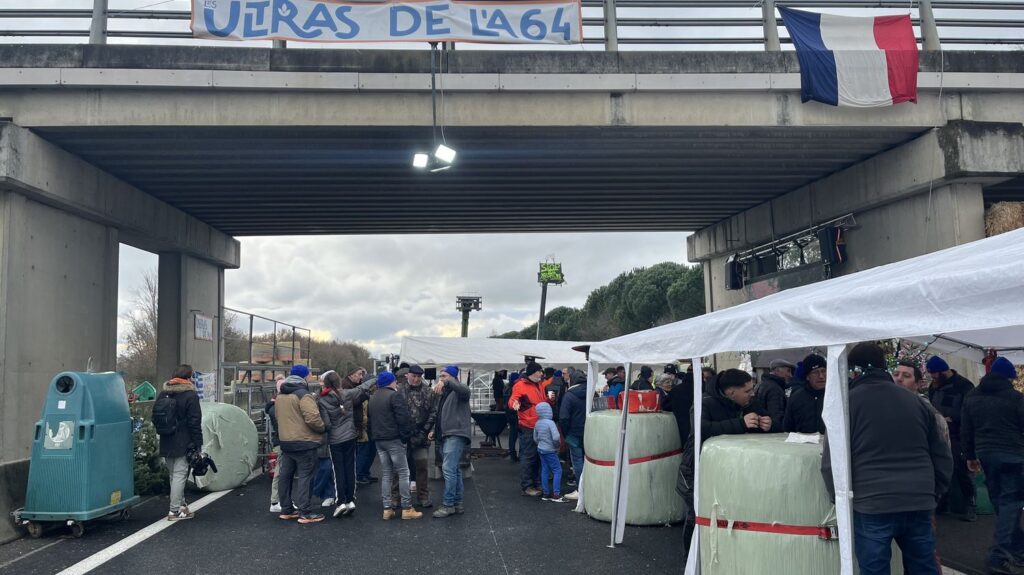
The bitter cold does not discourage them in any way. “Our job is to be outside in any season,” recalls one of the farmers, amused by the remark. On the motorway which connects Bayonne to Toulouse, while certain blockages have been lifted in recent days, members of the Les Ultras movement on the A64 do not intend to leave the bridge at the Carbonne motorway interchange (Haute-Garonne). When franceinfo went to meet them, Monday December 22, the hundred or so people and their supporters present, without a union, were beginning their eleventh day of mobilization.
“I’ve only missed two evenings since the beginning”, proudly says Benjamin Asna, a Gascon cow breeder in Castex (Ariège), while preparing his lunch among the abundant grills. The thirty-year-old works on his farm with his father, his sister and an employee, who had to take leave for the holidays. “He had to cancel them.” Everyone takes over with the animals so that the young man can stay on the dam, day and night. “I sleep on this folding bed”, he points, from the makeshift marquee built under the bridge. “Finally, I’m asleep, that’s quick to say,” he corrects himself.
For him, the first sleepless nights began when an Ariège farmer, “father of a rugby friend”, discovered a case of contagious lumpy skin disease among his animals in Bordes-sur-Arize. As soon as the slaughter of some 200 animals was announced, the Ultras of the A64, alongside unions, mobilized, installing barricades on the road towards the farm, and confronting the police. “We were attacked and gassed,” says Benjamin Asna. Two days later, the Carbonne blockade was put in place.
:quality(50)/2025/12/22/img-4799-6949796b2cabe509269087.jpg)
“Here is the HQ, this is the starting point of everything”, proudly announces Lionel Denat, 41 years old, dairy producer in Castillon-de-Saint-Martory (Haute-Garonne). “It was already here two years ago,” he remembers. On these same roads, a blockage lasted around ten days in January 2024. No lumpy skin disease then, but the same desire to denounce the difficult conditions in which farmers have to work. Faced with this mobilization, the Prime Minister at the time, Gabriel Attal, made the trip to try to calm the anger.
Two years later, the motivation is intact, assures Jérôme Bayle, leader of the movement. “We want to remain a stronghold of mobilization, we want to continue to defend our territory,” he explains. The man with the build of a rugby player sees in the difficulties of local farmers one of the reasons for this mobilization which continues in this part of the country. “We are the territory with the lowest agricultural yield in France. We have 90 cereal farms in receivership in Haute-Garonne alone,” he continues, briefly interrupted by a delivery of Bordeaux cannelés from solidarity traders.
Everyone we met intends to change the protocol for treating lumpy skin disease. France’s position on the free trade agreement with Mercosur member countries is also discussed. To discuss these subjects, the leader of the protest must be received late Tuesday afternoon by the prefect.
“The best way to make us leave is not the police, it is to respond to our demands.”
Jérôme Bayle, leader of the Les Ultras de l’A64 movementat franceinfo
Michel, 58, from Montesquieu-Volvestre (Haute-Garonne), details the increasing challenges. He says he has suffered three episodes of hail since May, enough to seriously damage crops. Furthermore, it is not far from the case of lumpy dermatosis identified in Bordes-sur-Arize (Ariège). His animals have been vaccinated but, with the necessary incubation time, he plans “a month of stress”. Working alone most of the time, the fifty-year-old goes back and forth across the block, between the two milkings per day necessary for his dairy cows. “I have my son who helps me, but at 17, he doesn’t just think about the farm.”
Not far from him, colleagues report bad news about a new case of dermatosis discovered in the area. The concern does not wait for the information to be made official by the prefecture before taking up residence. “Anyway, if it happens to me, I won’t report it”slices one of them.
:quality(50)/2025/12/22/img-4788-69497a01af57b743126353.jpg)
To combat anxiety, and in the face of unanswered demands, some of them resign themselves to spending Christmas at the dam. In this gray ensemble that represents the highway, fir trees have been installed and dressed with garlands. “We have already planned to cook the capon on a spit,” adds Benjamin Asna. Priests from the area also volunteered to celebrate a Christmas mass on Wednesday evening for the Catholic demonstrators. Gérard Bellecourt, 57 years old, cereal grower, plans to be one of the mobilized farmers: “Yes, if necessary, I will be there at Christmas, to the detriment of my four children and my wife.” “We don’t really have the mood to celebrate anyway”he specifies.