The association, present in 36 French cities, has 350 host companies and allows a homeless person to be housed for several months and accelerate their integration process.
:quality(50)/2023/07/07/64a7df4c5fe71_placeholder-36b69ec8.png)
Published
Reading time: 5min
:quality(50)/2025/12/21/2860-694828420de4b316736114.jpg)
When businesses house the homeless. For five years, the Bureaux du Cœur association has allowed people in integration, supported by social organizations, to sleep for a few months in unoccupied offices at night or on weekends, while they find other accommodation. This year alone, 500 people benefited from this temporary accommodation. The association started from the observation that “70% of the time, businesses are unoccupied”while she believes that “at the same time in France, 350,000 people sleep outside”.
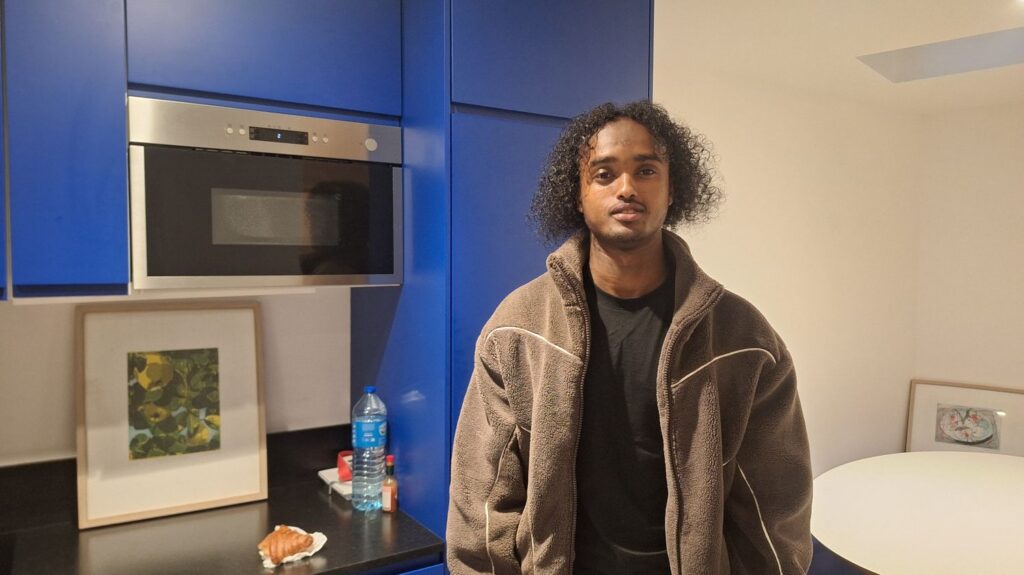
This is the case of the Parisian financial advisory company Sevenstones, located in the 9th arrondissement of Paris, which welcomes, outside of its office hours, Ismaïl, a 25-year-old Somali in a precarious situation. In these offices, located on three floors, where around ten employees work during the day, a meeting room becomes, after 7 p.m., the bedroom of the young homeless person. For eight months, Ismaïl has also had access to other areas of the company: the kitchen, toilets and shower.
After five months of sleeping on the street, Ismaïl still can’t believe it, “it was very difficult outside, today I live like at home, it’s nice, I’m very happy.” A reaction that makes Léo smile, financial analyst who leads the project internally, “Our offices are unoccupied at night and on weekends. There is no one there, and yet people sleep outside.” Especially since this approach “is super simple to set up”, and did not require much adjustment for the company. There was already a kitchen and a shower within Sevenstones, “we set up a little sleeping area with a bench and bought a blanket”Leo says. Since the start of the year, three people have been accommodated in the offices of the Sevenstones company.
:quality(50)/2025/12/21/2856-694828bd75a1f548435772.jpg)
Rules are imposed for those we call “guests”, you must leave before 9 a.m., return after 7 p.m., “but on weekends access is possible all day”, and don’t go upstairs where there are offices, Leo lists. It is above all “a relationship of trust”adds the financial analyst. “There are no locks, no cameras,” and there has never been any problem, he insists. Today, Ismaïl works 20 hours a week in a fast-food restaurant. He earns less than 1,000 euros per month, which for the moment does not allow him to find accommodation in the Paris region. So, every week, Léo takes stock with Ismaïl of his search for housing and work. “When he has to write his CV, I can help him because I know how to do it, so that he can find a job to complement the one he already has, to increase his income and his chances of finding accommodation behind.”
Leo’s case is not isolated. Within the companies that are part of the system, many employees are personally involved, “it recreates social bonds and it’s ultra-important”, develops Kinda Garman, general director of the Bureaux du Cœur association. “Yet the Heart Offices project is only supposed to intervene in the part of stabilizing housing for a given time”she adds. This helps speed up the integration process for the homeless. She specifies that on average, “The guests” four and a half months left.
“80% of people welcomed within the framework of the Bureaux du Cœur have a positive and stabilized situation upon leaving reception: obtaining accommodation in the private or social sector or a place in a home.”
Kinda Garman, general director of the Bureaux du Cœur associationat franceinfo
Reception takes place during “three months, renewable once, but we can go up to 9 months in certain large cities, notably in Paris, where there is a little more pressure on housing”explains the general director of the association Kinda Garman. Bureaux des cœurs is present in 40 cities in France and Europe (Lausanne, Brussels, Lisbon), including 36 French with 350 host companies. “We have more and more companies welcoming us, sometimes small ones like a psychologist’s office, as well as large multinationals,” rejoices Kinda Garman. She reminds us that becoming a host “costs nothing on a company scale” : “For most, it is enough to buy a convertible sofa, which can easily be found on second-hand sites, and for the rest, many companies have brought their employees together so that they can bring a sheet that they do not use, a bedside lamp, etc.”
Kinda Garman acknowledges that this is not “not the primary role of companies” than welcoming the homeless, and making up for the lack of emergency accommodation places. “It should be the role of the State, but in the meantime, people are in a precarious situation” she says. Partner establishments can benefit from a specific clause in their insurance contract to cover them in the event of a problem, at no additional cost.