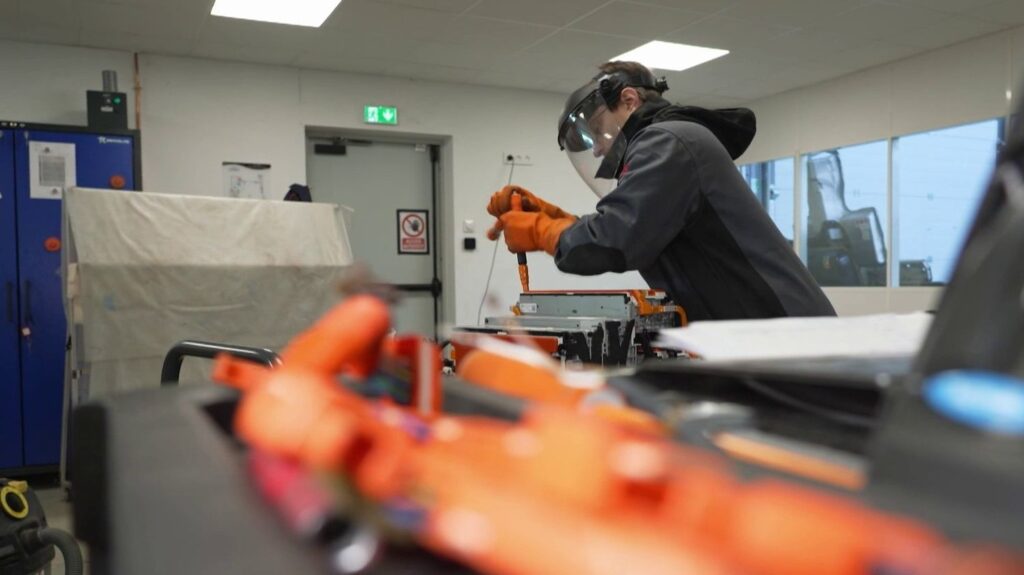
After the explosion which left four injured in the Elkem chemical factory, near Lyon, the question of surveillance of Seveso sites arises.
:quality(50)/2023/07/07/64a7df4c5fe71_placeholder-36b69ec8.png)
Published
Reading time: 3min
:quality(50)/2019/07/08/php6QBtou.jpg)
Four employees were injured on Monday, December 22, including at least two seriously, in an explosion that occurred early in the afternoon in the Elkem Silicones chemical factory in Saint-Fons, in the “chemistry valley” south of Lyon. A site classified Seveso, that is to say high risk.
This incident raises the question of the surveillance of such sites. Guest on franceinfo Tuesday December 23, Paul Poulain, engineer specializing in industrial risks, believes that controls are far too insufficient today in France.
Franceinfo: For you, is there a problem surrounding controls on Seveso sites?
Paul Poulain: Yes, there is a problem where these sites are actually controlled every year, unlike many other dangerous sites, with less volume of substances. In this case, on these Seveso sites, in France, an inspection team spends on average four days on a file while in Spain we spend on average ten days and in Germany 20 days. And that explains why we cannot go so far and limit the number of industrial accidents which, since Lubrizol, vary but remain at a level which is very very high.
How can we review controls on Seveso sites in France today?
For this, considerable resources and resources must be put in place. After the Lubrizol fire in Rouen in 2019, there was an announcement of 50 recruitments, but this is clearly insufficient, especially since we had increased the workforce by 2% to increase controls by 50%. This is not very credible. We would need to recruit around 8,000 people out of a workforce of around 1,200 full-time equivalents to achieve anything serious. And to finance it, we would need to free up budgets from the actors who create these risks.
Do controls only rest on companies?
Fortunately, there are still controls by state services, otherwise it would be much worse. But we must go much further and this is why we should create an independent safety authority for Seveso sites, or even for all dangerous sites in France, like what exists in nuclear power, so that it is no longer the prefects who must arbitrate between the economic development of the territories on the one hand, and the health and safety of the population and workers on the other.
Is it difficult to close a factory because it is too dangerous?
Today it’s too complicated. And besides, when we compare, it is much easier to close an establishment open to the public, like a nightclub, than a dangerous site. This can be explained because it is more complex. But on the other hand, this does not encourage manufacturers to push the safety lever as much as possible.