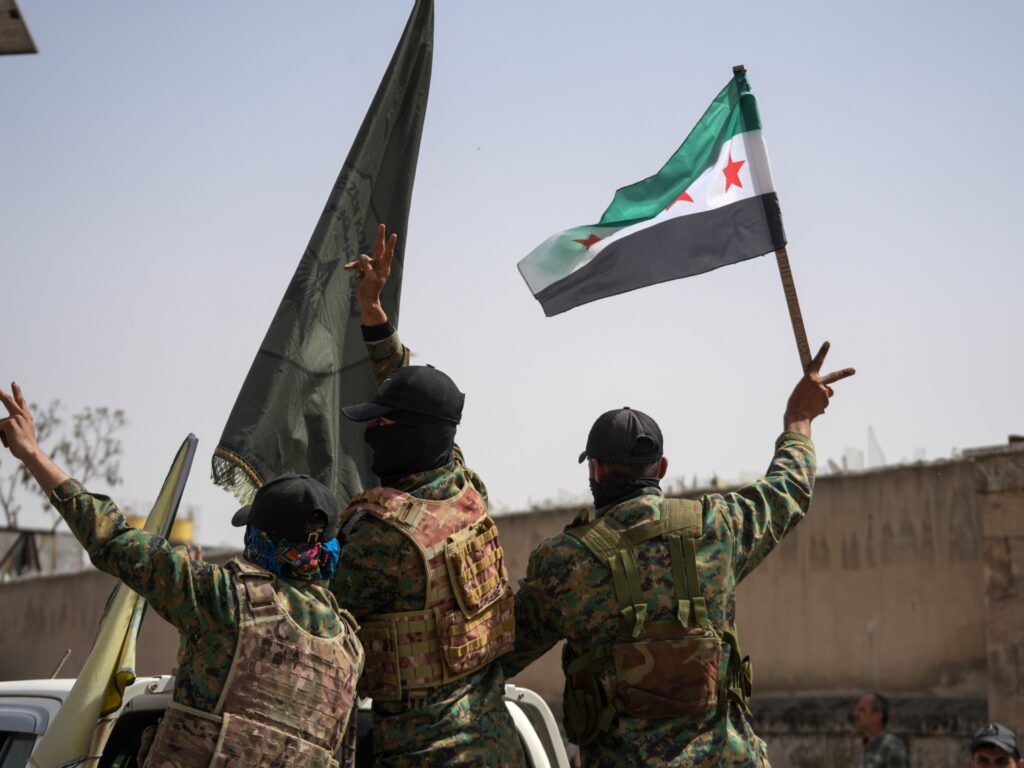
Clashes between Syrian government forces and the Kurdish-led Syrian Democratic Forces (SDF) in Syria’s second-largest city, Aleppo, did not come in a vacuum.
Tensions between the two sides have been high as an end-of-year deadline to incorporate the SDF into the Syrian armed forces approaches.
Recommended Stories
list of 3 itemsend of list
The fighting erupted on Monday afternoon during a visit by Turkish Foreign Minister Hakan Fidan but had ended by that evening after the two sides agreed to halt firing.
Analysts told Al Jazeera that the SDF, led by military leader Mazloum Abdi (also known as Mazloum Kobani) and the Syrian government, have seemingly reached an impasse on how to integrate the Kurdish fighters into the new state military structure and that a failure to find a serious deal could lead to renewed bouts of fighting or military confrontation between the two sides.
“The red lines of the (Kurdish) self-administration on one hand, and Turkiye/Damascus on the other, do present some striking incompatibility, and I do not see a way that the two can be reconciled,” Thomas McGee, the Max Weber Fellow specialising on Syria at the European University Institute in Florence, told Al Jazeera.
Negotiations
On March 10, the new Syrian government in Damascus, led by Ahmed al-Sharaa, and the SDF signed a historic agreement that planned to integrate the latter group into Syria’s new armed forces by the end of 2025.
The SDF is largely made up of members of the People’s Defense Units (YPG), the military wing of the Syrian branch of the Kurdistan Workers’ Party (PKK). The PKK is labelled a “terrorist” organisation by the United States, the European Union and Turkiye.
The agreement was seen as a means of avoiding a potentially explosive confrontation between Damascus and the US-trained SDF. However, 10 months on, while the agreement has helped the two sides avoid clashes, little progress has been made.
”For there to be any progress on implementing this point, one side would have to give way … as such, the status quo prevails,” McGee added.
A point of contention seems to be between the SDF’s preferred position of incorporating their existing battalions into the Syrian armed forces with a degree of autonomy, versus Damascus’s preferred position of the individual integration of SDF fighters.
Analysts told Al Jazeera that these two positions were likely untenable and that an agreement didn’t seem imminent.
Turkiye has backed Damascus and even threatened unilateral military intervention should an agreement not be reached.
“We just hope that things go through dialogue, negotiations and peacefully. We don’t want to see any need to resort to military means again. But SDF should understand the patience of the relevant actors is running out,” Turkish Foreign Minister Fidan told Turkish state media.
After a decades-long armed rebellion by the PKK, Turkiye has reached a deal with the group to disarm and lay down its weapons. Despite Fidan’s strong words, analysts said it is unlikely it would want to undermine those talks by militarily confronting the SDF.
Kurdish self-administration
On December 8, the more than five-decade rule of the Assad regime ended, allowing millions of Syrians to return to their country amid hopes for a better future. This was particularly true in areas controlled by the SDF during Syria’s civil war; under Bashar al-Assad, Kurdish rights were restricted and many Kurds said they were treated as second-class citizens.
But during Syria’s revolution and the subsequent almost 14 years of civil war, the SDF controlled areas in the northeast – at times by force and against the will of Arab inhabitants – and was able to build a level of autonomy. Analysts said the group is hesitant to relinquish that power.
“In terms of Kurdish self-defence and ability of Kurds to make own decisions, they think they’ve now achieved something which they’ve never had before, and don’t want to give it up,” Robin Yassin-Kassab, a Syrian writer and co-author of the book Burning Country: Syrians in Revolution and War, told Al Jazeera.
Syrian Foreign Minister Asaad al-Shaibani said on Monday that the SDF ”showed no willingness” to integrate into the country’s central administration in Damascus.
Yet analysts say there is a deep mistrust between Damascus and the SDF and that the government could have taken some steps to build confidence.
“The government has failed to take advantage of certain opportunities to show good faith in implementing the agreement from its side,” McGee said.
He added that the government could have taken steps such as recognising Newroz as a national holiday or acknowledging the rife Kurdish statelessness that occurred under the Assad regime.
“Also, during my recent visit to Hasakah, many locals were commenting on the fact that services (such as civil documentation) that had been available to them through the Security Squares of Qamishli and Hasakah under the Assad regime are no longer in place since December last year,” McGee said.
Little progress
Syria’s new administration has gained substantial international and regional backing, and that could have built its confidence in its dealings with the SDF.
The US, in particular, has grown closer to Damascus in recent months, with al-Sharaa making a historic visit to the White House and seemingly winning the approval of US President Donald Trump.
The US also trained and armed the SDF in its fight against ISIL (ISIS). But Trump’s special envoy to Syria, Tom Barrack, has said the US supports the SDF integrating into the Syrian state and that it would not like to see the SDF breaking away to form an autonomous entity or even a semi-autonomous region like Iraqi Kurdistan. Barrack also praised the ”reasonable options” presented by the government to the SDF.
“The US want the SDF to integrate into the new Syrian transitional government but don’t want the SDF – Damascus to descend into conflict because it will create more opportunities for ISIL to pop up in vacuums,” Wladimir van Wilgenburg, an analyst of Kurdish politics based in Erbil, told Al Jazeera.
On Friday, Reuters news agency reported that Damascus “expressed openness to the SDF reorganising its roughly 50,000 fighters into three main divisions and smaller brigades as long as it cedes some chains of command and opens its territory to other Syrian army units”.
However, officials also told Reuters a deal didn’t appear to be imminent and more talks were needed.
Still, analysts said the March 10 deal signed by al-Sharaa and Abdi in Damascus did have a positive impact in limiting clashes.
“It is notable that there has been extremely little direct conflict between the Syrian government and self -administration since the signing of the agreement, indicating that at least the provision relating to the ‘ceasefire’ has broadly held,” McGee said. “Other provisions have clearly, however, seen little progress.”
It’s still unclear how Monday’s clashes may affect the deal, and analysts say the prospect of SDF fighters integrating into government forces before the end of 2025 is unlikely.
“The deadline is approaching fast but some officials say it’s more important to implement the agreement than focus on the deadline, so there could be an extension,” van Wilgenburg said.