
MP Fatma Mseddi formally denied the authenticity of a document which circulated widely on social networks between December 23 and 24, 2025 and which is attributed to her. She claims that it is a falsified document, written and distributed without her consent, and announces her intention to take legal action against its author.
According to her statements, Fatma Mseddi recognizes neither the content nor the origin of this correspondence supposedly addressed to the President of the Republic, Kaïs Saïed. She accuses by name a certain Makhlouf Boulbeba of “false and falsification” of a document signed in his name, denouncing an attempt at political and media manipulation.
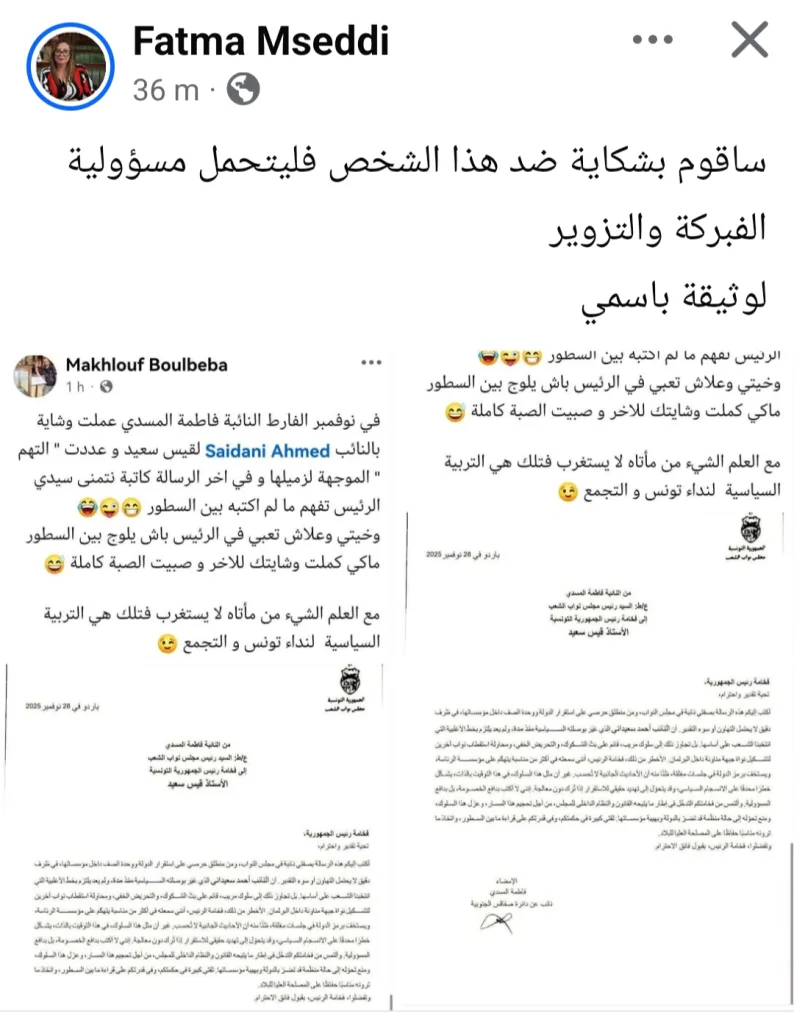
A controversial document widely relayed
The document in question, distributed on social networks, presented itself as a letter addressed by the MP to the Head of State, in which she implicated her colleague Ahmed Saidani for behavior deemed « suspects ». The text notably mentioned a supposed change in political orientation, criticisms formulated privately against the presidential institution, as well as alleged attempts to form a core of internal opposition within the Assembly.
In this letter, attributed to Fatma Mseddi, Ahmed Saidani was described as a deputy who “changed his political compass for some time” and no longer respecting “the line of the majority on which the people elected us”. The document denounced behavior “suspicious, based on the diffusion of doubts, subtle provocation and the attempt to recruit other deputies to form an internal opposition core”.
The text went further, affirming that the deputy would have, on several occasions, “made fun of the presidential institution and despised the symbol of the State during private sessions”thinking that these remarks would remain without consequences.
The correspondence also called on the President of the Republic to “intervene within the framework permitted by law and internal regulations” in order to “contain this course, isolate this behavior and prevent it from transforming into an organized situation that could harm the State and the dignity of its institutions”, thus equating political disagreement with an institutional threat.
For his part, Ahmed Saidani has recently been critical of the president and his entourage, pointing out governance failures without ever calling into question the legitimacy of the power in place.
A schoolboy style of denunciation
The form and tone of this document had provoked numerous reactions, with some observers seeing it as a return to practices of political denunciation reminiscent of methods that were believed to have been obsolete since the 2011 Revolution.
Very formal in its structure, the text was distinguished by a surprisingly academic tone. It read in particular: “I do not write out of animosity, but out of responsibility,” a formulation evoking more of a clumsy justification than an assumed political act. The letter, saturated with emphasis and honorifics such as “I have great confidence in your wisdom”, gave the image of a confusing mixture of servility and denunciation.
R.B.H