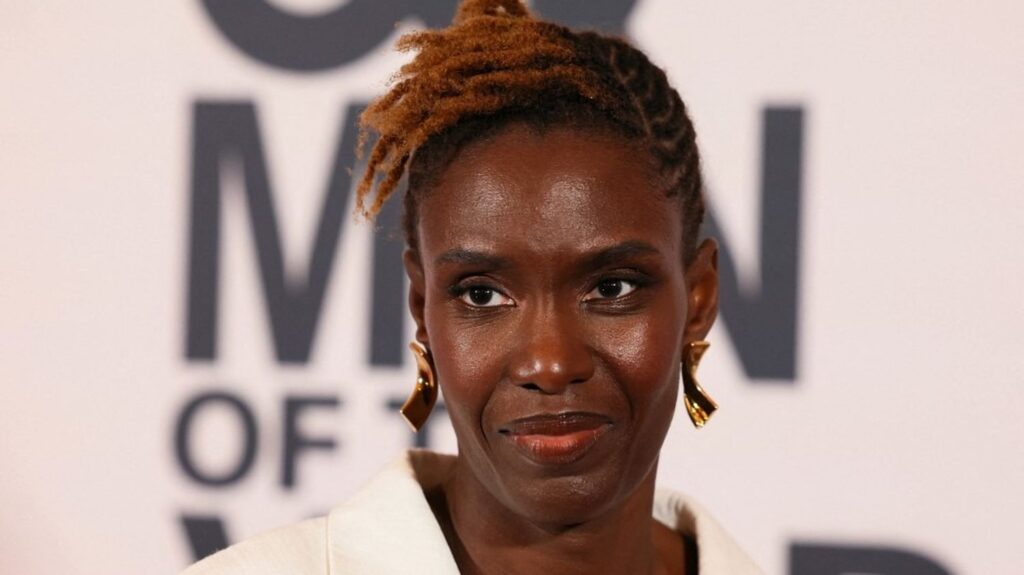
“Charlie Hebdo” is “incapable of confronting the ideas of a black woman without reducing her to a dancing, exoticized, supposedly wild body,” wrote the essayist on X. The satirical newspaper defends itself, speaking of “manipulation,” and denies any racism.
:quality(50)/2023/07/06/64a68815cd1a7_placeholder-36b69ec8.png)
Published
Reading time: 3min
:quality(50)/2025/12/25/000-346p6q3-694d44fe56ec3646447486.jpg)
The journalist and decolonial activist Rokhaya Diallo denounced, Wednesday December 24, a “hideous drawing” published by Charlie Hebdo which represents her with a belt of bananas at her waist, reminiscent of the outfit worn by the artist and resistance fighter Joséphine Baker. “(II) aims to remind me of my place in the racial and sexist hierarchy”, wrote Rokhaya Diallo on the social network “in line with colonial imagery”.
Charlie Hebdo East “incapable of confronting the ideas of a black woman without reducing her to a dancing, exoticized, supposedly wild body”, she added.
For its part, the satirical newspaper denies any racism. On the same social network, Charlie Hebdo writes that this drawing, signed by its director Riss, illustrates an article from a special issue “on the gravediggers of secularism”, titled “Rokhaya Diallo, America’s Little Bride”. “Everyone will be able to read that we denounce the positions of the essayist against the law of 1905, which she has always condemned by preferring American communitarian culture”, continues Charlie Hebdo.
“Seeing a racist reference is a manipulation to which she has unfortunately accustomed us,” writes the newspaper team. She accuses Rokhaya Diallo of assigning “everyone has their own ethnic and religious origin, against republican universalism”.
Conversely, Rokhaya Diallo estimated that “the reference to Joséphine Baker (East) precisely what is racist”, emphasizing that there was no “no link” between her and the Franco-American singer and dancer. Joséphine Baker had become a star with the show Negro magazine (1925), where she danced wearing a banana belt. “By resuming the imagination of “African savage”, she satisfies the public’s demand for exoticism but she also takes power by mocking racial stereotypes which she ends up transcending“, underlined in 2021 to AFP Michell Chresfield, history researcher at the University of Birmingham, a few days before the artist’s pantheonization.
Charlie Hebdowhose editorial team was decimated by an Islamist attack in 2015, and Rokhaya Diallo have already clashed in the past around the notions of universalism and secularism, which ideologically fracture the French left.
The essayist received the support on Wednesday of a large number of elected officials from La France insoumise as well as the boss of the Socialist Party, Olivier Faure. The latter denounces a drawing which “just repeats the racist codes of the colonial era.”
Christiane Taubira, former Minister of Justice under François Hollande, for her part judged the drawing “infamous” And “intellectually destitute.”