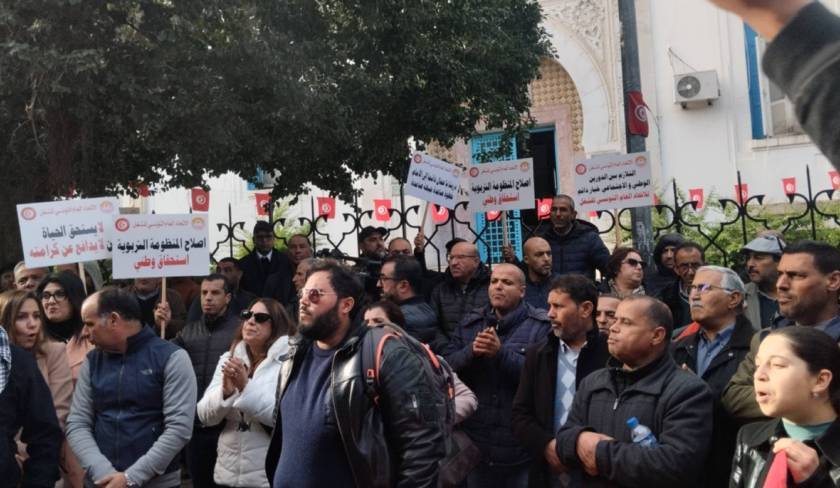
Mohamed Safi, secretary general of the General Federation of Secondary Education under the Tunisian General Labor Union (UGTT), returned, Thursday, December 25, 2025, to the day of anger and the protest rally organized the same day in front of the Ministry of Education. In a telephone interview given to Myriam Belkadhi in the Midi Express show on Express Fm, he strongly criticized the breakdown in dialogue with the supervisory authority and reaffirmed the demands of the sector.
“Constrained” mobilization during the holidays
Asked about the choice to organize this mobilization during school holidays, Mohamed Safi explained that this decision aimed precisely to avoid any direct disruption of classes and to prevent possible administrative sanctions. He accused the Ministry of Education of adopting a repressive approach, marked, he said, by salary deductions.
The union official stressed that this day of anger is part of a series of forms of struggle already engaged during the year 2025. He recalled the organization of regional and national protest movements on February 26, 2025, as well as sit-ins observed on August 28, 2025, during the summer holidays. According to him, despite correspondence addressed to the ministry in accordance with current practices, no concrete response has been provided.
Mohamed Safi accused the Department of Education of refusing any dialogue with the union structures representing the different educational bodies, whether secondary education, basic education, supervisors, administrative executives or, more broadly, the entire educational body.
Boycott of second term assessments and exams
Addressing the issue of escalation, Mohamed Safi confirmed that the decision of the sectoral administrative commission provides, in addition to the protest mobilization, the boycott of all evaluations and exams for the second term of secondary education, including orals, supervised homework, practical work as well as end-of-term exams.
He justified this choice by the closing, according to him, of all doors to dialogue and by what he considers to be a clear non-compliance with agreements previously concluded. He notably mentioned significant delays in the application of promotions, speaking of several months not taken into account to the detriment of the teachers concerned.
Mohamed Safi also returned to the agreement signed on May 23, 2023, providing for a salary increase spread over three years. He expressed his incomprehension regarding the statements of the Minister of Education before the Assembly of People’s Representatives, suggesting that this file would still be ” under study “. According to him, the signed agreements bind the State, regardless of changes in governments or ministers, and must be applied without renegotiation.
Parental concerns and union rights
Responding to a question on the expected reaction of parents and students to the exam boycott, Mohamed Safi acknowledged that this decision would neither be popular nor favorably received. However, he considered that the primary responsibility lies with the supervisory authority, which he accuses of serious failings.
He warned of the fact that many students, in different regions of the country, would not have benefited from lessons in certain fundamental subjects, such as Arabic, mathematics, physics or technology. He described this situation as a serious attack on the principle of equal opportunities, asserting that students would find themselves evaluated without having received the required teaching.
According to him, resorting to a boycott constitutes a painful but necessary choice to defend a union right deemed legitimate, while reaffirming that the solution requires the immediate resumption of negotiations.
Total lack of communication with the ministry
Mohamed Safi assured that no contact, neither official nor unofficial, has been established recently with the Ministry of Education. He spoke of a generalized climate of fear, saying that even informal telephone exchanges with certain administrative officials had stopped.
He indicated that the federation had nevertheless sent several correspondence to request meetings, particularly on the occasion of the start of the school year, the movement of transfers and the implementation of the agreement relating to directors and principals. He denounced unilateral management of the educational file, based, according to him, on superficial solutions from the ministry, which only aim to improve the situation without tackling the real problems.
An alarming diagnosis of the education system
The general secretary of the secondary education federation drew up an observation which he described as “ catastrophic » of the situation in educational establishments. He highlighted the glaring lack of teachers, both in basic education and in secondary education, as well as the overload of hours imposed on teachers, citing volumes of up to 26 hours per week, in contradiction with existing agreements.
According to him, this situation weighs heavily on teachers and seriously compromises the quality of teaching. He affirmed that the unease is widely shared within the educational body, including among inspectors, and estimated that public schools are going through a deep crisis without precedent in its union career.
Internal context of the UGTT and continuity of action
Finally, questioned about the recent resignation of the general secretary of the UGTT and its repercussions on union action, Mohamed Safi stressed that this was an unprecedented event, while expressing the hope that internal dialogue would make it possible to move beyond this stage.
He insisted on the fact that decisions in the secondary education sector are taken collegially, following regular consultations with the executive office and the sectoral administrative commission. He affirmed that the federation will continue to assess the situation and take, “ with courage », the decisions it deems necessary.
Mohamed Safi concluded by recalling that the UGTT is a historic organization, which cannot be confiscated by individuals, and called for remaining faithful to the heritage and struggles that have shaped the Tunisian trade union movement.
Remember that the UGTT declared a general strike on January 21, 2026. The strike movement should respond to three central demands: the effective establishment of social dialogue, the defense of the right to negotiation and union rights, as well as the rejection of the salary increase integrated into the 2026 finance bill for the public and private sectors, without prior negotiations.
I.N.