This week, an artist helps us understand how the road has transformed our environment.
:quality(50)/2023/07/07/64a7df4c5fe71_placeholder-36b69ec8.png)
Published
Reading time: 3min
:quality(50)/2025/12/27/couv-la-route-une-histoire-dessinee-694f8e4c3d7e1167104436.jpg)
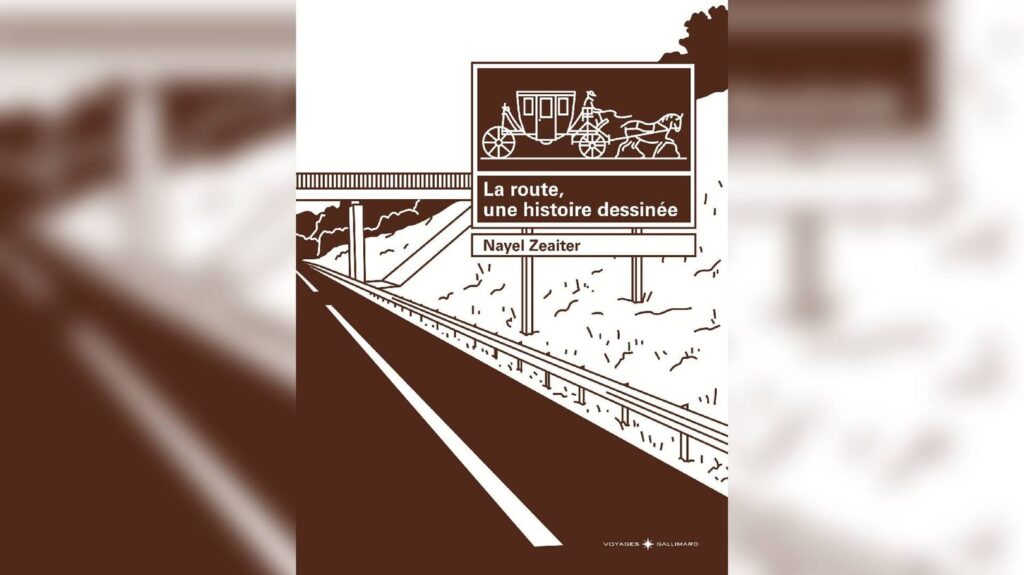
It is a journey that Nayel Zeaiter offers us, a journey through the history of the road and everything that has driven or still drives on the road.
Carts, carriages, omnibuses, buses, trucks, cars, bicycles, all of this is represented in a sort of fresco which unfolds over the pages. We thus discover how the road developed in France, how it has shaped our society, especially since the advent of the automobile.
We recall, for example, how roads multiplied in the 1960s in so-called “peri-urban” areas. Where we built houses, housing estates, areas where the car became essential. Where the price of fuel is, even today, a very sensitive subject, as we saw with the Yellow Vests.
Obviously, with more than 700,000 kilometers of municipal roads, 380,000 kilometers of departmental roads, 11,000 kilometers of national roads and 12,000 kilometers of motorways, the road is everywhere around us, it forms a universe that has had to be gradually codified.
We see in the book how France was gradually covered by what seems so familiar to us today, everything which illustrates the permanent struggle between speed and security. The very first signs, at the beginning of the 20th century, the first lines drawn on the ground in the 1930s, the arrival of the Stop sign in 1971, the proliferation of roundabouts in the 1980s. And then the abundance of street furniture which is today trying to get a makeover, in the form of rocks or flower boxes.
Nayel Zeaiter pays particular attention to the highways, which crisscross the country, seem to show us around, notably with these famous brown signs to indicate the presence of a remarkable heritage. And this, even though the landscape offered to us is often artificial: it has been subjected by the road, flattened, dug, recomposed by landscapers and artists to give an impression of naturalness.
There is, the author tells us, a “true highway aesthetic”with also monumental works of art, appearing in the 1970s/1980s: The Cathedral Spiers on the A10, The Cathar Knights on the A61 or even The Infinity Sign on the A6. There are more than 80 such works; they are often criticized, ignored, and yet they also bear witness to this culture of the road which has transformed our country in just a few decades.