Palestinian Christians have gathered at the Church of the Nativity in Bethlehem for the first time since Israel’s genocidal war in Gaza began in 2023 to celebrate Christmas.
Bethlehem’s mayor says the municipality has chosen to restore the city’s festivities after a long period of darkness and silence.
At a Christmas market, Safaa Thalgieh, a mother from Bethlehem, told Al Jazeera’s Nida Ibrahim: “Our joy doesn’t mean people are not suffering, have lost their loved ones, or are desperate, but we can only pray that things get better.”
Palestine: The birthplace of Christianity
Palestinian Christians make up some of the oldest Christian groups in the world.
According to the Bible, Mary and Joseph travelled from Nazareth to Bethlehem, where Jesus was born and placed in a manger. The Church of the Nativity was built at this location, and its grotto holds great religious significance, attracting Christians from all over the world to the city of Bethlehem every Christmas.
However, making that trip today would be very different due to several Israeli checkpoints, illegal settlements, and the separation wall, as highlighted in the map below.

Palestinian Christians living under Israeli occupation
Once a thriving community, the number of Christians living in the occupied West Bank, East Jerusalem, and Gaza is now fewer than 50,000, according to the 2017 census, making up about 1 percent of the population.
In the early 20th century, Christians made up about 12 percent of the population. However, Israel’s illegal occupation of the West Bank has squeezed communities, created economic hardships, and deprived them of the conditions needed to exist on their land, pushing many families to seek a more stable life abroad.

Most of Palestine’s Christians live in the West Bank and East Jerusalem, totalling approximately 47,000 to 50,000, with an additional 1,000 in Gaza before the war.
The Christian population in the West Bank is highly concentrated in three main urban areas:
- Bethlehem governorate (22,000–25,000): This is the largest concentration, centred in Bethlehem and the surrounding towns of Beit Jala and Beit Sahour.
- Ramallah and el-Bireh (10,000): A major administrative and economic hub, including nearby historic villages like Taybeh, Birzeit, and Jifna.
- East Jerusalem (8,000–10,000): Primarily located in the Christian Quarter of the Old City and neighbourhoods like Beit Hanina.
Like the rest of the Palestinian population, Palestinian Christians are subjected to Israeli military control, settler violence, and a legal system that discriminates against them.

Israeli attacks against Christians and churches
Across Palestine, Christian communities and their churches have faced numerous attacks by Israeli forces and members of the Israeli public.
The Religious Freedom Data Center (RFDC) has been monitoring violence against Christians through an incident hotline operated by volunteers and activists.
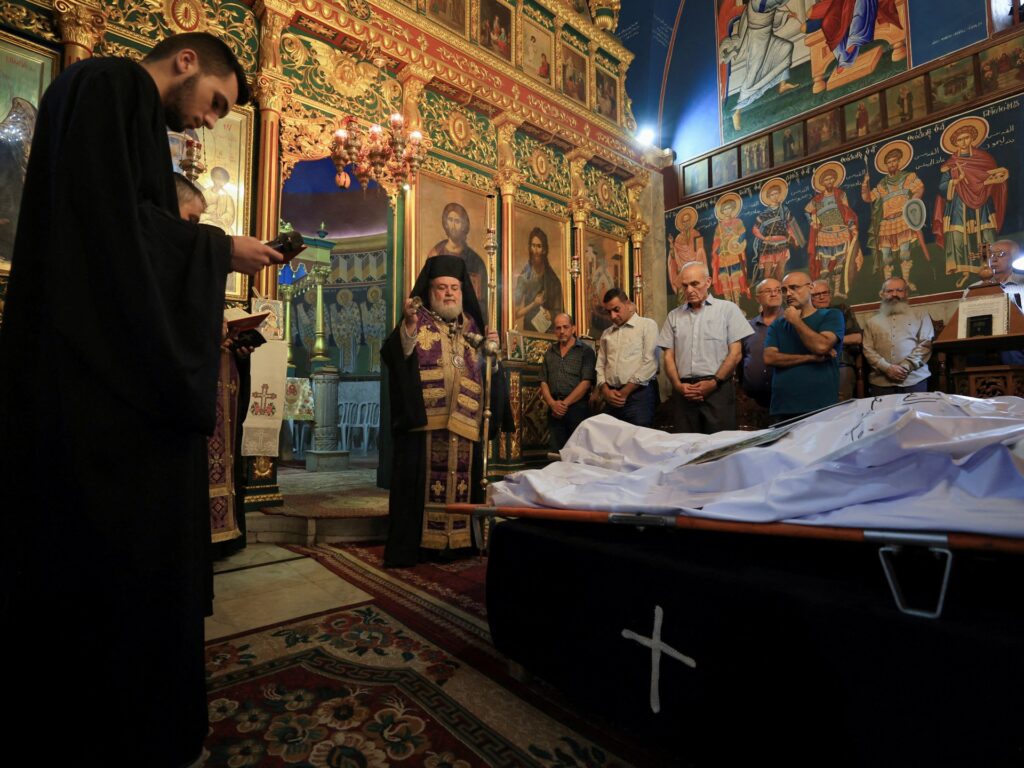
Between January 2024 and September 2025, the group documented at least 201 incidents of violence against Christians, primarily committed by Orthodox Jews targeting international clergy or individuals displaying Christian symbols.
These incidents include multiple forms of harassment, including spitting, verbal abuse, vandalism, assaults and more.
The majority (137) of these incidents took place in Jerusalem’s Old City, located in occupied East Jerusalem.

Jerusalem holds profound significance to multiple faiths, including Muslims, Jews, and Christians, and is home to many holy sites. One of the most notable for Christians is the Church of the Holy Sepulchre, where Christians believe Jesus was crucified, buried and resurrected.
In 2025, Christian communities in the occupied West Bank faced an alarming surge in targeted violence and land seizures.
In the predominantly Christian town of Beit Sahour, just east of Bethlehem, Israeli settlers, backed by the military, bulldozed the historic Ush al-Ghurab hilltop in November to establish a new illegal settlement outpost.
Meanwhile, in Taybeh, the predominantly Christian town in the West Bank, the ancient St George Church was targeted by arsonists in July.
In June, a group of Israelis was filmed attacking the Armenian Monastery and Christian holy sites during a raid on the Armenian Quarter in the Old City of East Jerusalem, which has come under attack numerous times.

In Gaza, numerous places of worship, including churches, have been attacked by Israeli forces.
An Open Doors report from early 2025 estimated that roughly 75 percent of Christian-owned homes in Gaza have been damaged or destroyed since the start of Israel’s genocidal war.
On October 19, 2023, Israeli forces attacked Gaza’s oldest Greek Orthodox Church of Saint Porphyrius, killing at least 18 displaced people, including children who were seeking shelter in the church.
The church, built in 1150, was Gaza’s oldest active place of worship and had been serving as a multi-faith sanctuary for hundreds of civilians.
A grief-stricken father told Al Jazeera that his three children were killed in the blast. “We sought refuge here, thinking it was a safe haven – our last safe haven, in a church. The house of God,” he said. “They bombed my angels and killed them without warning.”
Israeli forces have also repeatedly attacked the Holy Family Church, Gaza’s only Roman Catholic church, which has long served as a refuge for the local Christian community.
On November 4, 2023, an air attack on the church compound partially destroyed a school inside the complex. The attacks continued in July 2025, when an Israeli tank shell struck the church, killing three people and wounding several others.
The Holy Family Church has long held symbolic importance beyond Gaza. Throughout the war, the late Pope Francis called the parish almost daily, maintaining a direct line to the besieged community.