/2025/12/23/broadjvs7ci-694a4e5a889f0712504153.jpg)
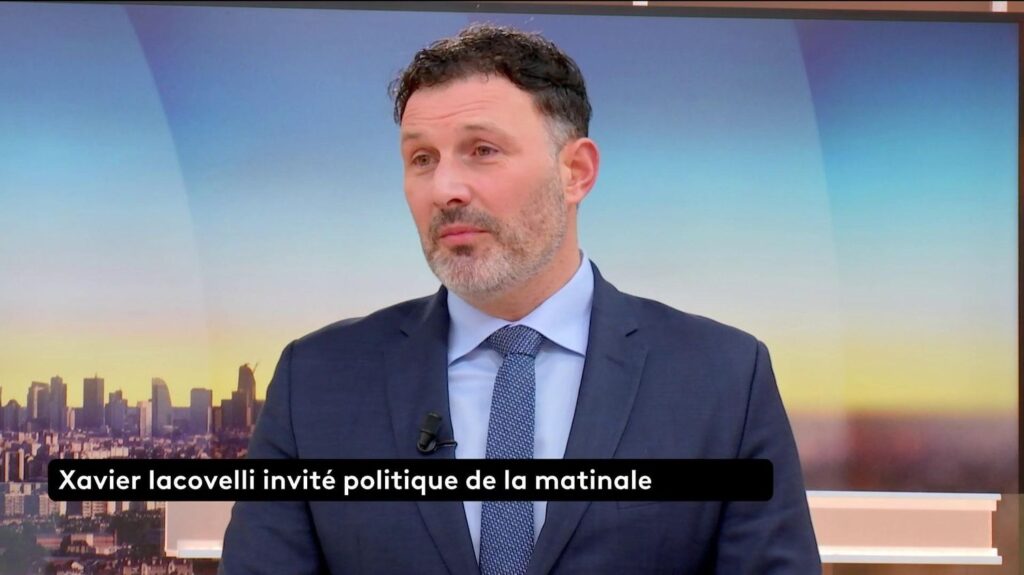
Xavier Iacovelli, Renaissance senator for Hauts-de-Seine and vice-president of the Senate, was the political guest of La Matinale de franceinfo. He returned to the absence of a budget for 2026 and the examination of a special law intended to ensure a minimum service, calling for a rapid parliamentary compromise. He defended the government’s strategy aimed at avoiding, initially, the use of 49.3, while recalling that the Prime Minister would take his responsibilities in the event of failure of the negotiations, in order to avoid the use of orders and a worsening of the public deficit.
This text corresponds to part of the transcription of the interview above. Click on the video to watch it in full.
Zohra Ben Miloud: You are aware that France does not have a budget and that it risks waking up, on January 1, without a finance law. A special bill was therefore presented last night to the Council of Ministers. It will be examined in the Senate as in the National Assembly. This law must ensure a minimum service. With hindsight, do you think that Sébastien Lecornu’s strategy, consisting of avoiding the use of 49.3 at all costs, was the right one?
Xavier Iacovelli: I think it was the only strategy to reach a compromise, at least on part of the budget. I remind you that when the Barnier government fell last year, it was over the social security financing bill. Today, this project exists, but we still do not have a finance bill for the state budget. We must now find an agreement on this text. This is the whole point of the discussions that the Prime Minister continues to lead. He has also decided to give Parliament another chance from January 5, even if discussions continue between Christmas and New Year’s Day.
Amélie de Montchalin, Minister of Public Accounts, warned that it would not be a quiet vacation for deputies and senators. Do you really think that resorting to 49.3 is not the solution, even though it sets a clear deadline at the end of January? Clearly, if no agreement is found, it will be necessary to force it.
What is certain is that the Constitution offers the government several tools, notably ordinances and 49.3. The Prime Minister indicated that he did not wish to use either the orders or 49.3 before December 31. On the other hand, these options will be legally possible from January 1. They are constitutional instruments. And, at one point, the Prime Minister reminded us yesterday, during the consultations, that he would take his responsibilities if Parliament proved incapable of finding a compromise.
As vice-president of the Senate, you inevitably hear what is said in the corridors, including in the National Assembly. Do you have the feeling that the oppositions are now in a real logic of negotiation? Can we hope to find a compromise? The discussion worked for Social Security, but not for the state budget. How to get out of this impasse?
I think we are not far from it. No one has an interest in seeing the government resort to orders, which would be much more painful for the French. It should be remembered that, in this case, the budget would be established on the basis of the initial text tabled by the government in October, without taking into account parliamentary debates, amendments or progress resulting from the work of Parliament. No one wants to reach this situation, especially a few weeks before the municipal elections. I therefore believe that everyone is aware of the need to quickly find an agreement.
The opposition we receive – just yesterday a MEP from the National Rally – speaks very firmly. To summarize, he told us: “We were fooled in 2025, we will not be fooled in 2026. We must hold on, and we will hold on.”
If you are talking about extreme right or extreme left oppositions, effectively, there is no discussion possible. They do not want to contribute to the development of a budget.
Without them, you do not have the necessary majority to pass a budget.
This is why I am calling today on all political forces which aspire to exercise responsibilities tomorrow and which are in moderation: the Republicans, the Socialists and a large part of the Environmentalists. We must find compromises to provide France with a budget. It’s essential. I would like to remind you that the special law is not a budget: it simply renews the appropriations for 2025 and ensures a minimum service.
Let’s take two concrete examples. The special law will make it possible to continue paying apprenticeship aid for young people hired in September. On the other hand, schemes like MaPrimeRénov’, which could start in January, would remain suspended.
And there are even more worrying consequences. We will not be able to recruit, neither in the justice system nor in the Ministry of the Interior. However, a new cyberattack targeted La Poste services yesterday. How can we focus on other political issues, and how can we prepare for the increase in cyberattacks, if we remain stuck in this situation?
Let me say it clearly: it is not ours to bear this responsibility. We made proposals. We are in favor of recruiting more police officers and magistrates. You also have to look at the numbers. A special law maintained throughout the year would lead to a public deficit of 5.6%. The budget as discussed and amended by Parliament reduces this deficit to 5.3%. However, for a budget to be sustainable for the French and for the economy, we should aim for a deficit of less than 5%.
We are therefore talking about several billion euros that we will not be able to cover, neither today nor tomorrow. It’s not just a question of future generations: without agreement on reducing our spending, the situation will quickly become unmanageable.
This text corresponds to part of the transcription of the interview above. Click on the video to watch it in full.