Published
Reading time: 6min – Video: 7min
:quality(50)/2025/10/01/video-17-68dd952f1f287875580316.jpg)
7 minutes
A few days ago, producers of French tomatoes were angry with competition from Moroccan tomatoes. Thousands of tonnes are sold in France. A Franco-Moroccan company that holds this juicy business has agreed to open its doors to the France Télévisions teams.
This text corresponds to part of the transcription of the report above. Click on the video to watch it in full.
A few kilometers south of Agadir (Morocco), the land where herds of dromedaries are crossed are among the most arid in Morocco. The French Télévisions teams are traveling to the heart of one of the largest vegetable gardens in the world. Under greenhouses covering the horizon, work thousands of workers. The small hands of the tomato. “I earn 9 euros per day”indicates an employee.
On the farm, women pick barely ripe tomatoes so that they can endure the 15 days of traveling them. The vast majority of tomatoes will soon be sold on the stalls of French supermarkets. “Each year, we export 30,000 tonnes of tomatoes. And we will say that we send around 20,000 tonnes to France”Indicates Youness Bougarba, Quality Quality MAR Director.
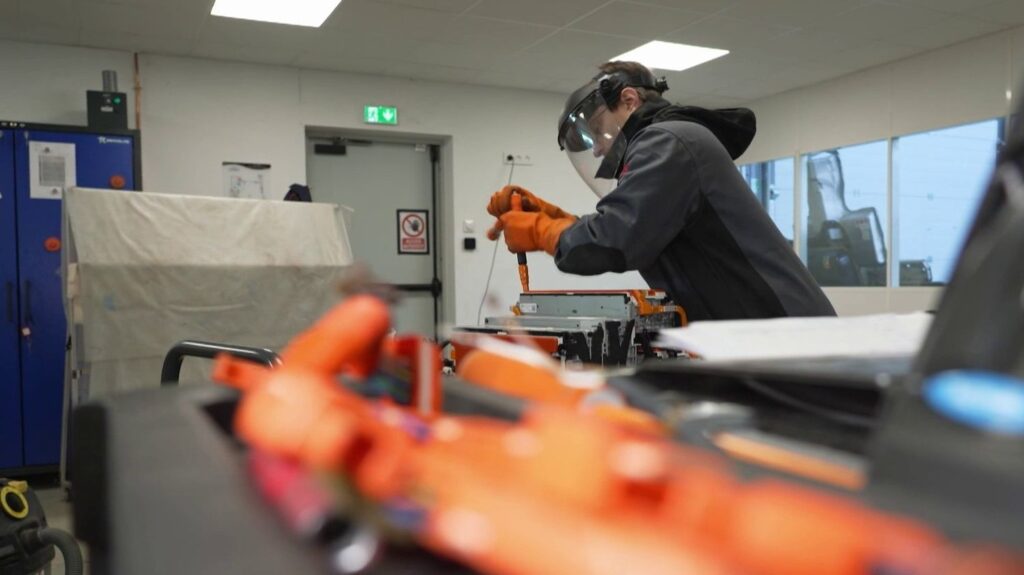
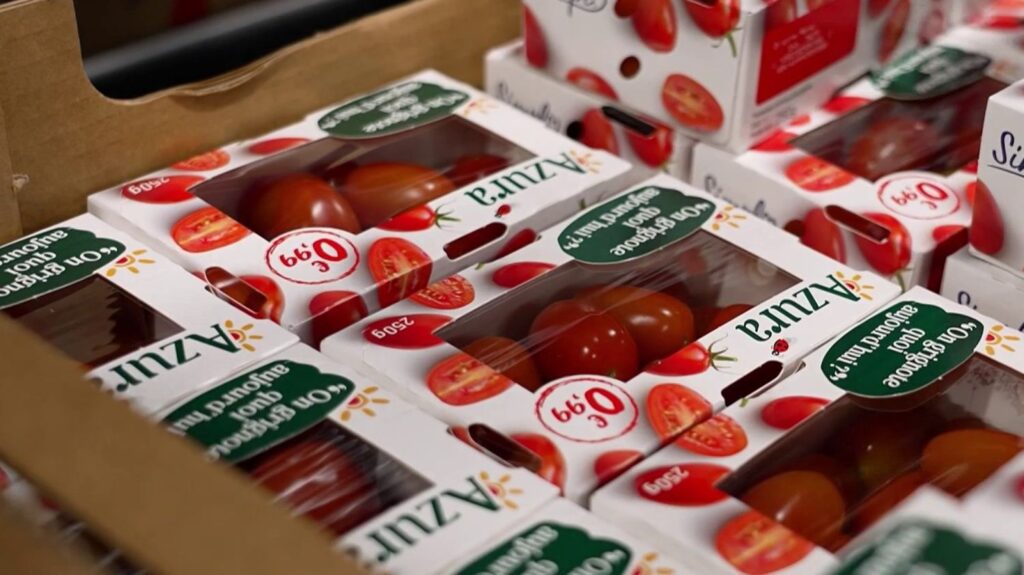
France and Europe are the first recipients of Moroccan tomatoes. In 25 years, exports to the European Union have even been multiplied by four. The production has exploded and today the greenhouses cover the entire region of Agadir. A major player in this big leap forward: the Franco-Moroccan group Azura. For the first time, the sector leader authorized cameras to film the huge warehouse where 4,000 people work. The sorting channels would be at the cutting edge of technology. As proof, we are told, a machine that tracks the slightest defect on each tomato. “The machine can treat up to 1.2 million tomatoes per day, which is equivalent to an average of 65 tonnes per day. And for each fruit, there are several photos, up to 8 photos per tomato, which really allows us to obtain precision”Ensures Mohassine Mehdaoui, director of the Azura group packaging station. The machines would make it possible to further draw production costs down and offer always cheaper tomatoes to consumers, such as boxes sold in our supermarkets at 99 cents, two to three times cheaper than their French competitors. “Honestly, I do not understand that it annoys. As an economic operator and as a country, we are not allowed to develop?”ABIR LEMSEFFET, Director General of the AZURA group.
With ultra -modern factories, the Moroccan tomato industry faces a danger capable of upsetting its dreams of greatness. The water is gradually lacking. On the farms, we must go and extract it ever more deeply. According to scientists, global warming, but above all the exhaustion of water tables by agriculture, are at the origin of the lack of water.
Faced with the shortage, the richest producers buy desalked seawater. The Benelasri family does not have the means. For decades, over fifteen hectares of land, she cultivated fruits and vegetables. But five years ago, deprived of irrigation, Abdullah Benelasri chose, like more than a dozen farmers in the surrounding area, to end the family farm. “When my brother told me I stop, I said no, it’s not possible. I had a lot of trouble accepting this. Besides, I think he had to feel it”, explains Aicha Benelasri, resident of Zaouit in Massa. “”We cultivated so much vegetables and now nothing. We are unemployed “Sharing Abdullah Benelasri. By pride, Abdullah Benelasri did not wish to join the cohorts of workers employed by the large farms in the surroundings.
Under the greenhouses, however, the workforce is lacking. According to our information, several agadir companies would even call on illegal migrants from sub -Saharan Africa. On social networks, videos show Ivorians, Senegalese, Guineans working illegally in farms. There are even announcements for jobs.
In the suburbs of Agadir, the French Télévisions teams meet a man who denounces the exploitation of migrants in farms. He is one of the managers of a sub -Saharan community on site. “At the last census they did at Agadir level, there were about 7,000 migrants. 90 % work in fields”he says.
He offers us to meet these migrant workers. But while we have been driving for a few minutes, he has been receiving a call. We are followed by Moroccan security services. After a few detours, we finally reach an apartment out of sight. We are waiting for a man and a woman there. Without a residence permit or employment contract, they claim to collect vegetables for foreign markets. Both describe very difficult working conditions and say they have to spread pesticides, sometimes with bare hands. “Often we are sick. We are not protected”, they explain.
After our shooting, we tried to contact the company that uses them. But neither her nor the local association of producers responded to our requests. In Morocco, the tomato industry is a flagship that does not wish to extend over some of its manufacturing secrets.