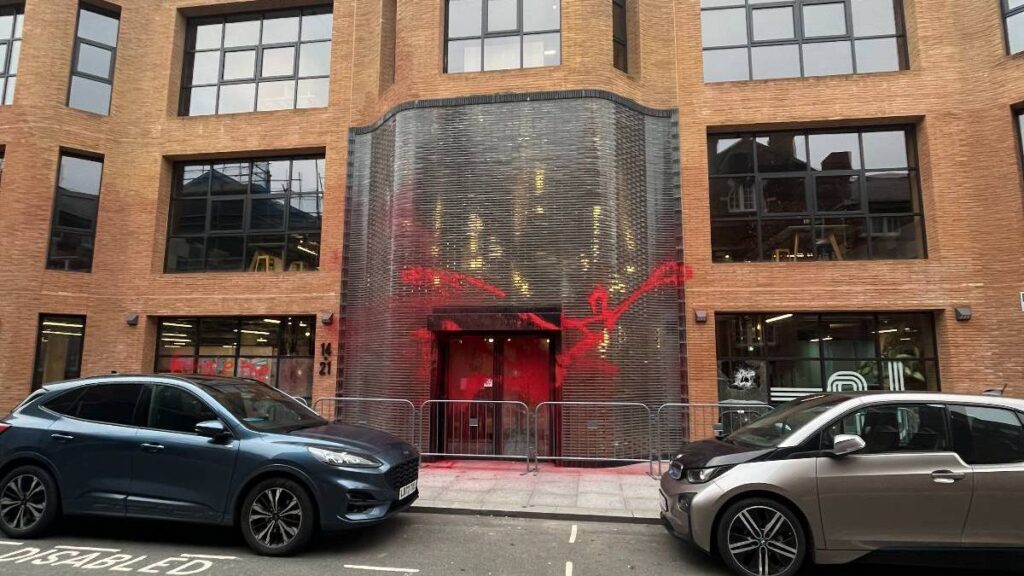
Pro-Palestine activists have sprayed red paint and smashed windows at the offices of the United Kingdom’s Labour Party in London, saying the action is in solidarity with prisoners on hunger strike in British jails.
The group Justice for the Hunger Strikers said on Monday that its members had targeted the governing party, citing growing anger at what it described as the government’s refusal to engage with the hunger strikers.
Recommended Stories
list of 4 itemsend of list
The protest was held as four detainees continue to refuse food while being held on remand awaiting trial, prompting increasing concern from doctors and campaigners that one or more could die.
Four other detainees have since ended their hunger strike but have said they plan to resume it in the new year.
Hunger strike enters critical stage
Heba Muraisi is on day 57 of her hunger strike and is being held in a prison in West Yorkshire.
In a statement shared exclusively with Al Jazeera on Monday, she said: “I’ve been forced fed repression and I’m stuffed with rage and that’s why I’m doing what I’m doing now. I am bringing acute awareness to the unjust application of UK laws by our Government and I’m glad that people can now see this after a year of imprisonment and human rights violations. Keep going, keep fighting.”
The three other detainees still on hunger strike are Teuta Hoxha on day 51, Kamran Ahmed on day 50 and Lewie Chiaramello on day 36. Hoxha and Ahmed have previously been hospitalised during the protest.
A spokesperson for Justice for the Hunger Strikers criticised the Labour government, saying it has failed to intervene despite advance warning of the hunger strike.
“Despite being given two weeks notice of the hunger strike, the Labour government has refused to engage with the hunger strikers or their families and legal representatives, even as they have reached a critical stage, with death a very real possibility,” the spokesperson said.
The hunger strikers are being held in five prisons across England over their alleged involvement in break-ins at the UK subsidiary of the Israeli defence firm Elbit Systems in Bristol and at a Royal Air Force base in Oxfordshire.
The detainees deny the charges against them, including burglary and violent disorder, and said the UK government should itself be held accountable for its alleged role in Israel’s genocidal war on the Palestinian people.
All eight hunger strikers are members of Palestine Action and were charged before the group was designated a proscribed organisation under “antiterrorism” laws. They are expected to spend more than a year in prison before their trials begin – well beyond the UK’s usual six-month pretrial detention limit.
According to the Prisoners for Palestine group, their trials are expected to begin between April and January 2027.
The detainees’ demands include release on bail, an end to what they describe as interference with their mail and reading materials, access to a fair trial and the de-proscription of Palestine Action.
Additional demands issued this week include transferring Muraisi back to HMP Bronzefield, closer to her family; lifting non-association orders between prisoners; and allowing detainees access to prison activities and courses.
International concern
Campaigners have described the protest as the largest hunger strike in Britain since the Irish hunger strikes of 1981, saying it has prompted hundreds of solidarity demonstrations across the country.
On Friday, a group of United Nations experts – including Gina Romero, the UN special rapporteur on the rights to freedom of peaceful assembly and association, and Francesca Albanese, the UN special rapporteur on occupied Palestinian territory – issued a statement expressing alarm at the detainees’ treatment.
“Hunger strike is often a measure of last resort by people who believe that their rights to protest and effective remedy have been exhausted,” the experts said. “The state’s duty of care toward hunger strikers is heightened, not diminished.”
Separately, more than 800 doctors have signed a letter addressed to Justice Secretary David Lammy urging him to intervene. The letter, written on December 17, raised “grave concern” about the prisoners’ health, warning they were at high risk of organ failure, irreversible neurological damage, cardiac arrhythmias and death.
Lawyers for the hunger-striking detainees said last week that they had initiated legal proceedings against the government, alleging it had abandoned its own prison safety policy. The detainees said they have written repeatedly to Lammy and other justice officials without receiving a response.
James Timpson, the UK minister of state for prisons, probation and reducing reoffending, said the government would not engage directly with the hunger strikers or their representatives.
“We are very experienced at dealing with hunger strikes,” Timpson said. “Over the last five years, we have averaged over 200 hunger strike incidents every year. I do not treat any prisoners differently to others. We have a justice system based on the separation of powers, and the independent judiciary is the cornerstone of our system.”