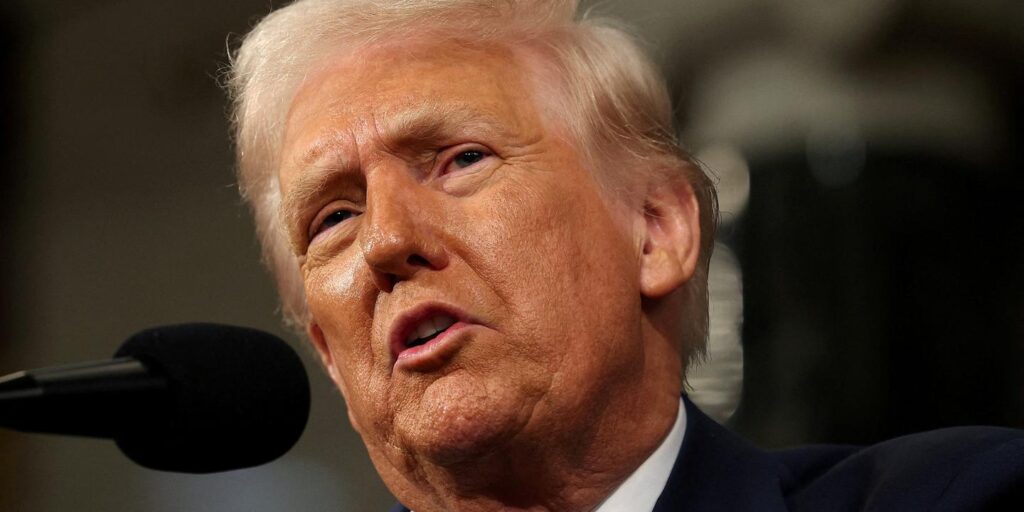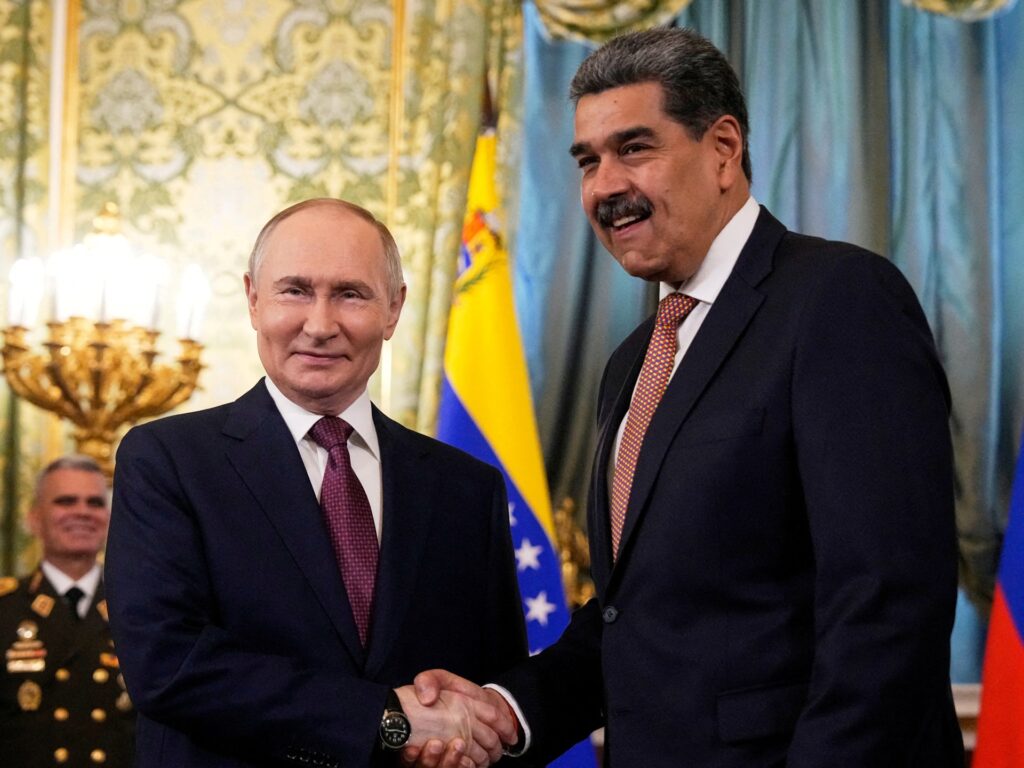
The escalation of threats to Venezuela by United States President Donald Trump may be easy to dismiss as one of his random whims, but it is too closely linked to major confrontations to be seen as a regional affair with limited impact on the rest of the world.
Venezuela is turning into a bargaining chip in the game of global superpowers, along with Ukraine.
Check the opening chapters in Antony Beevor’s history of World War II to see how seemingly disparate conflagrations on different continents – the Nanjing massacre in China, Mussolini’s invasion of Abyssinia and the Spanish Civil War – played their roles in the build-up to the most horrible carnage in modern history.
This is not to say the world is necessarily sliding into a third world war – although the threat of it is always there. So long as the main characters in Russia-US relations, Trump and his Russian counterpart Vladimir Putin, are currently more prone to mutually beneficial transactions than confrontation, a global bargain feels more likely than a global war.
Not a major power at all, Venezuela still matters globally – not only as a country with the world’s largest proven oil reserves, but also as a political ally of China, Iran and Russia – countries the US-led West sees as its archrivals. Of these three, Russia is the one which finds itself in the most delicate position when it comes to Venezuela. The US-driven escalation poses risks for the Kremlin, but there are also potential gains to be made.
The main factor is the unexpected thaw which happened in relations between the US and Russia during Trump’s second term as president.
Since Putin’s ascent to power in 2000, the Kremlin has seen the US first as an unreliable partner, then as a full-fledged adversary with an ambition to divide and rule in the ex-Soviet neighbourhood.
But it all suddenly went back to a partnership of sorts when Trump returned to the White House at the beginning of 2025. The US all but terminated its financial aid to Ukraine and adopted the posture of near-neutrality, though it still supplies crucial intelligence to the Ukrainian army. In the latest iteration of its National Security Strategy, the US even dropped Russia from the list of “direct threats”.
As peace talks over Ukraine, initiated by Trump, slowly proceed, Putin has good reasons to believe that the war is ending on his terms. Despite performative defiance, Ukrainian President Volodymyr Zelenskyy has recently suggested he could agree to his army’s withdrawal from the north of the Donbas region – the most punishing of Russian demands in negotiations. It was yet another concession he suggested he might be open to in 2025, with the Kremlin not moving one inch from its negotiating position.
Meanwhile, European Union countries have failed to agree on the reparations loan that could guarantee stable funding to Ukraine in the coming years. Although a cheaper alternative was devised in last-minute negotiations, the story demonstrated that the European commitment to Ukraine is reaching its limits.
Given all the above, it is hardly the best time for the Kremlin to spoil a difficult but all-in-all good working relationship with Trump’s administration over something as distant and unrelated to Russia’s core interests as Venezuela.
Yes, Russia would make all the expected noises. Its United Nations envoy, Vassily Nebenzia, has claimed that by threatening Venezuela, the US is engaging in “aggressive neocolonialism”. He said it is “cynically imposing its order as it tries to retain global domination and the right to exploit other country’s riches with impunity”.
This is in reference to the US openly demanding that Venezuela open up again to its oil companies, which controlled much of the country’s oil industry prior to its gradual nationalisation in the 1970s.
It is not as though Russia itself has no interest in Venezuela’s riches – Russian oil companies have joint ventures with the Venezuelan oil monopoly, PDVSA, although their history is chequered, not least due to US sanctions.
But Russia would not go out of its way to save a friendly Latin American government. Russian support for Venezuela will always be directly proportional to the US pressure exerted on Russia in connection with Ukraine.
The potential fall of Nicolas Maduro’s government is not going to be the end of the world for the Kremlin. Russia has a history of adapting to new political regimes that replaced its traditional allies in countries affected by the US obsession with regime change. Iraq and Syria both serve as good examples.
There is also the aspect of cynical political calculation. The geopolitical gains from the US launching a military attack on Venezuela potentially exceed the losses.
That is because it would put Russia and the US on an equal moral footing with regard to the war in Ukraine. If the US can dictate its will by means of military aggression in what Americans call “their backyard”, then why can Russia not do the same in its own? The US aggression in Venezuela would justify Russian aggression in Ukraine in the eyes of many, especially in the Global South. Handily for the Kremlin, it would also sow further divisions between the US and Europe as well as feed polarisation within the US itself.
If, in addition to Venezuela, the Trump administration presses forward with its irrational desire to occupy Greenland, the situation would be ideal for the Kremlin. It may even open avenues for post-Ukraine rapprochement with the EU-led part of Europe, currently its main global nemesis.
Generally, the Russians see themselves as the keepers of the old order, ultimate foreign policy conservatives. They see the US-led West as a revisionist force responsible for undoing the post-World War II order and see the war in Ukraine as a way of countering that revision.
But, as their thinking goes, if there is no return to the old order, for which the West is to blame, let us negotiate a new one: an order in which the US does as it pleases in its Western hemisphere, and Russia retains influence over the ex-Soviet neighbourhood.
An ideal scenario for Russia would be for the US to get bogged down in Venezuela for years. But if Maduro falls fast, it is OK, too. When the dust settles, the outcome might look like a transaction – a US-friendly Venezuela in exchange for the war in Ukraine ending on Russian terms.
The views expressed in this article are the author’s own and do not necessarily reflect Al Jazeera’s editorial stance.