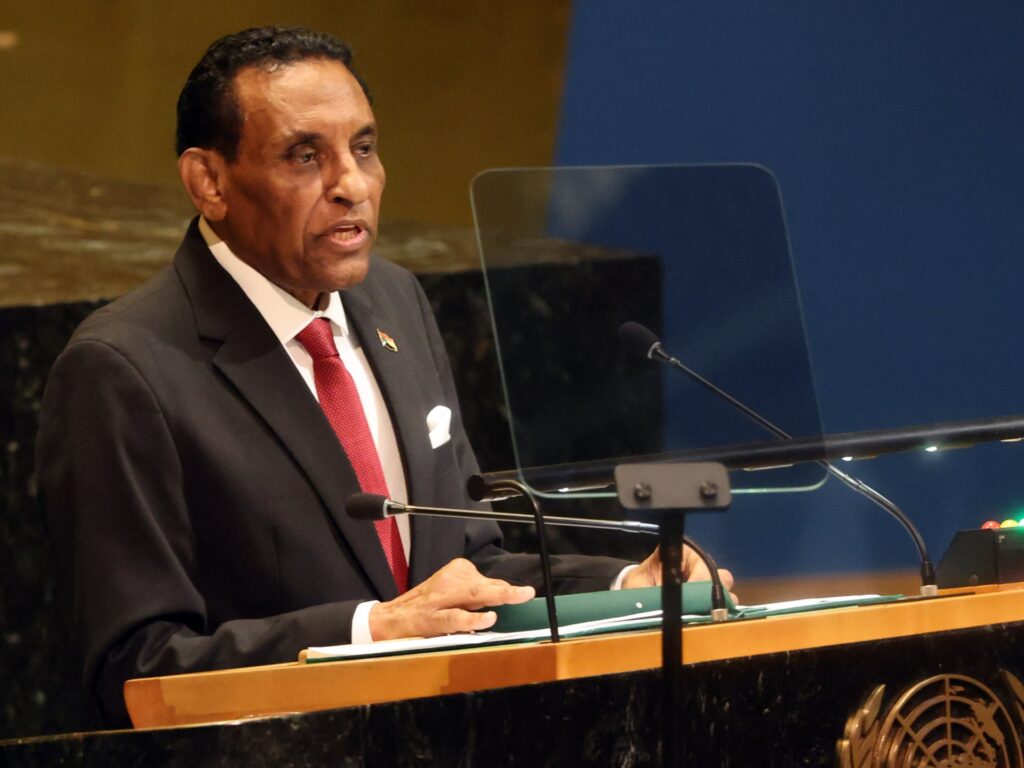
Sudan’s prime minister has presented a peace plan to end his country’s brutal war before the United Nations Security Council (UNSC), calling on members to stand “on the right side of history” by backing the initiative as fighting continued in Kordofan and North Kordofan States.
Addressing the UNSC on Monday, Idris outlined a plan to end the devastating war that would include a ceasefire monitored by the UN, African Union and Arab League, and the withdrawal of the Rapid Support Forces (RSF) paramilitary from territory they controlled.
Recommended Stories
list of 4 itemsend of list
The proposal would also see RSF forces, who have been engaged in fierce clashes with the Sudanese military since the conflict erupted in April 2023, being placed in camps and disarmed, a measure he said would be necessary for the truce to have any “chance for success”.
Idris also pledged to organise free elections following a transition period to allow for “inter-Sudanese dialogue”, and said the plans would also see RSF fighters not implicated in war crimes reintegrated into society.
“It is not about winning a war,” he said. “It is about ending a cycle of violence that has failed Sudan for decades.”
He appealed to the council’s 15 members to back the initiative, saying it could “mark the moment when Sudan steps back from the edge and the international community – you, you! – stood on the right side of history”.
As he addressed the UN, fighting has continued in Sudan, with the Sudanese army on Monday saying it had recaptured a town southwest of the city of al-Rahad in North Kordofan State.
In October, the RSF captured the city of el-Fasher in the western Darfur region, killing more than 1,500 people. Tens of thousands of people have been killed, and some 14 million displaced, by the war that erupted over a power struggle between the Sudanese Armed Forces (SAF) chief Abdel Fattah al-Burhan and the RSF chief Mohamed Hamdan “Hemedti” Dagalo.
Quad backs truce proposal
But US Ambassador Jeffrey Bartos presented a different proposal that focused on addressing the humanitarian crisis.
He urged the Sudanese government and the RSF to accept an alternative plan for a humanitarian truce, pushed by the US and key mediators Saudi Arabia, Egypt and the United Arab Emirates – known as the Quad – as the path forward.
“We urge both belligerents to accept this plan without preconditions immediately,” he said.
A Quad statement in September called for an immediate three-month truce to lead to a permanent ceasefire, humanitarian access to help civilians, and the creation of a political process for a civilian transition.
In early November, the RSF said it agreed to the humanitarian truce proposed by the Quad. But fighting has continued, with the heaviest clashes occurring in Kordofan, where at least 100 civilians have been killed since early December and more than 50,000 people displaced.
The UN says the war in Sudan has killed more than 40,000 people – although aid groups say the true number could be many times higher – and created the world’s largest humanitarian crisis, with disease outbreaks and famine spreading in parts of the country.
Fleeing violence amid RSF advances on their towns in the violence-wracked Kordofan region, some 1,700 internally displaced people – most of them women and children – have recently arrived at a displacement camp near Kosti, in White Nile State, officials say.
Reporting from the camp, Al Jazeera’s Mohamed Vall said it lacked adequate provisions to cope with the influx.
“They don’t have enough tents, they don’t have enough food, they don’t have enough equipment,” he said.
‘Homemade – not imposed on us’
In an apparent reference to the Quad-backed proposal for a humanitarian truce, Idris told the UNSC that his government’s peace plan was “homemade – not imposed on us”.
Reporting from the UN, Al Jazeera’s Gabriel Elizondo said Sudan’s announcement came towards the end of the meeting, and it was unclear how much support it had from the council members.
On the sidelines of the meeting, Elizondo asked Idris whether his proposal was realistic, in response to concerns raised privately by a number of UNSC members.
“I think so. It is realistic, it is doable, it is possible,” the Sudanese leader said.
But UAE Ambassador Mohamed Abushahab also backed the Quad’s humanitarian truce proposal, saying there was an immediate opportunity to get aid to Sudanese civilians in desperate need.
“Lessons of history and present realities make it clear that unilateral efforts by either of the warring parties are not sustainable and will only prolong the war,” he warned.