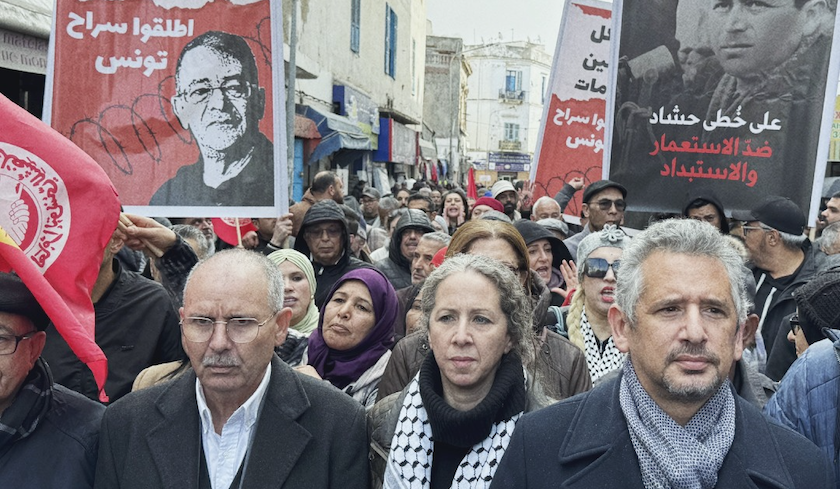
The official announcement of the resignation of Noureddine Taboubi from his post as secretary general of the Tunisian General Labor Union (UGTT) sparked a wave of reactions. Submitted Tuesday, December 23, 2025 at the registry of the Central Trade Union, this resignation, confirmed by Sami Tahri, deputy general secretary of the organization, comes in a context marked by a deep internal crisis and unprecedented structural tensions.
For several months, the UGTT has in fact been prey to acute internal dissensions, fueled by disagreements on the holding of the congress, the date of it, as well as on the general strike planned for January 21, 2026. These differences have gradually degenerated into a real war of influence between components of the central, weakening its unity and its governance. The organization is undermined from within with a power that blows on the embers, since several executives of the UGTT have joined the July 25 process.
In the wake of the announcement, reactions were not long in coming. Between political reading, union concern and militant anger, several voices – trade unionists, deputies and journalists, among others – spoke out revealing the depth of the divide currently crossing the union center.
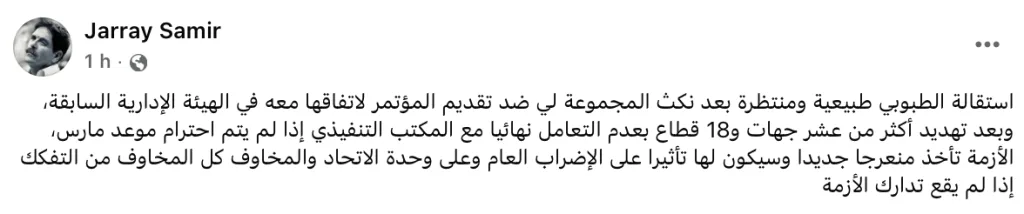
For some, the resignation of Noureddine Taboubi appears to be a predictable outcome. “ Taboubi’s resignation is natural and expected “, estimates Samir Jarray, emphasizing that “ the group which had engaged with him (Noureddine Taboubi, editor’s note) within the previous administrative body reneged on its agreements concerning the progress of the congress “. He also recalled that “ more than ten union structures and eighteen sectors had threatened to break all relations with the executive office if the March date was not respected “. According to his analysis, “ the crisis is now taking a new turn, with direct repercussions on the general strike and on the very unity of the UGTT“. He concluded by expressing “ serious fears of dislocation if the situation is not quickly brought under control ».
Other, more virulent reactions adopted an alarmist tone. “ The destruction of the UGTT will be a curse that will pursue you forever, one by one “, wrote Jilani Hammami, figure of the left, in a post on his Facebook page, adding: “ History will remember your names associated with an unforgivable crime ».

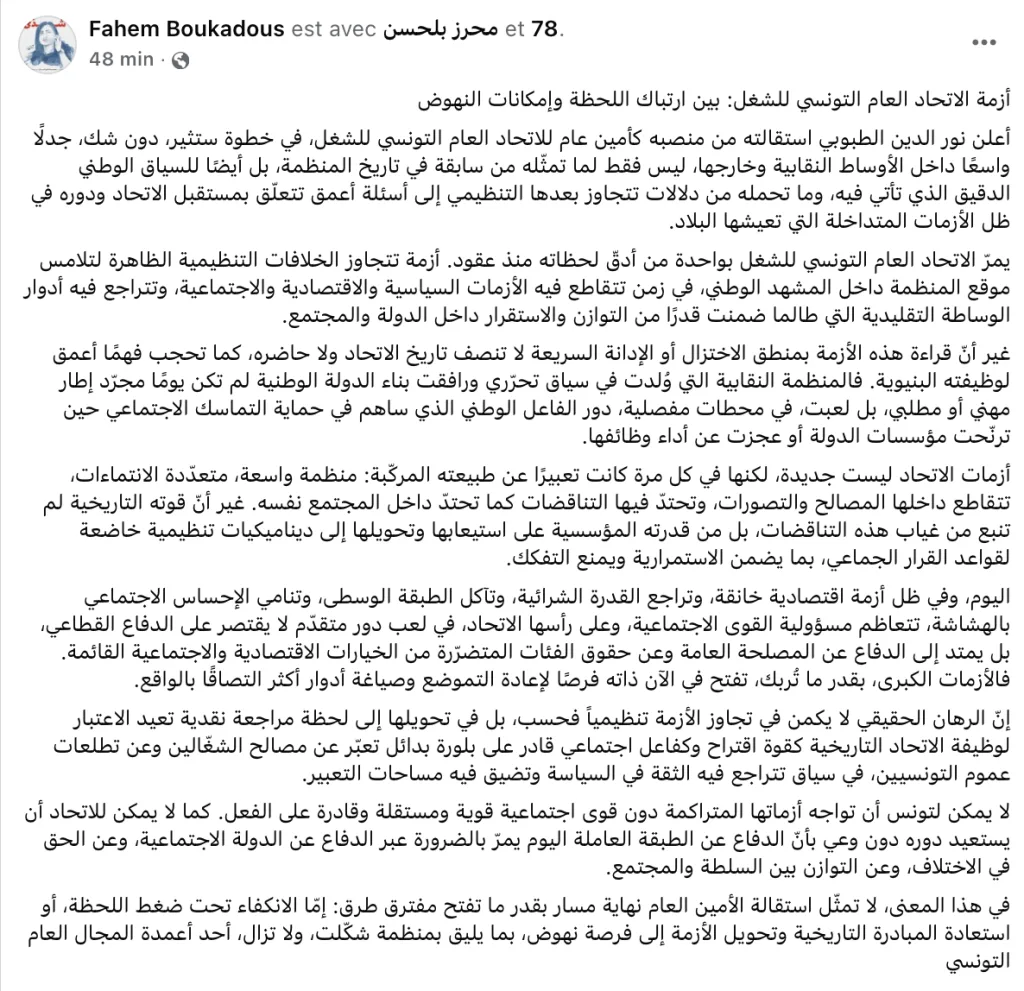
A more nuanced and analytical reading has also emerged. According to journalist Fahem Boukadous, the resignation of Nouredine Taboubi “ takes on an unprecedented character in the history of the organization, but it also draws its scope from the particularly sensitive national context in which it intervenes, as well as from the meanings it conveys, going well beyond its strictly organizational dimension to raise deeper questions about the future of the UGTT and its role in a national landscape crossed by multiple and overlapping crises. »
In his opinion “ the resignation of the Secretary General does not mark the end of a journey, but opens a strategic crossroads: that of a possible withdrawal under the pressure of circumstances, or, conversely, of a reconquest of the historic initiative, transforming the current crisis into an opportunity for renewal, at the height of an organization which has shaped, and continues to shape, one of the essential pillars of the Tunisian public space. »
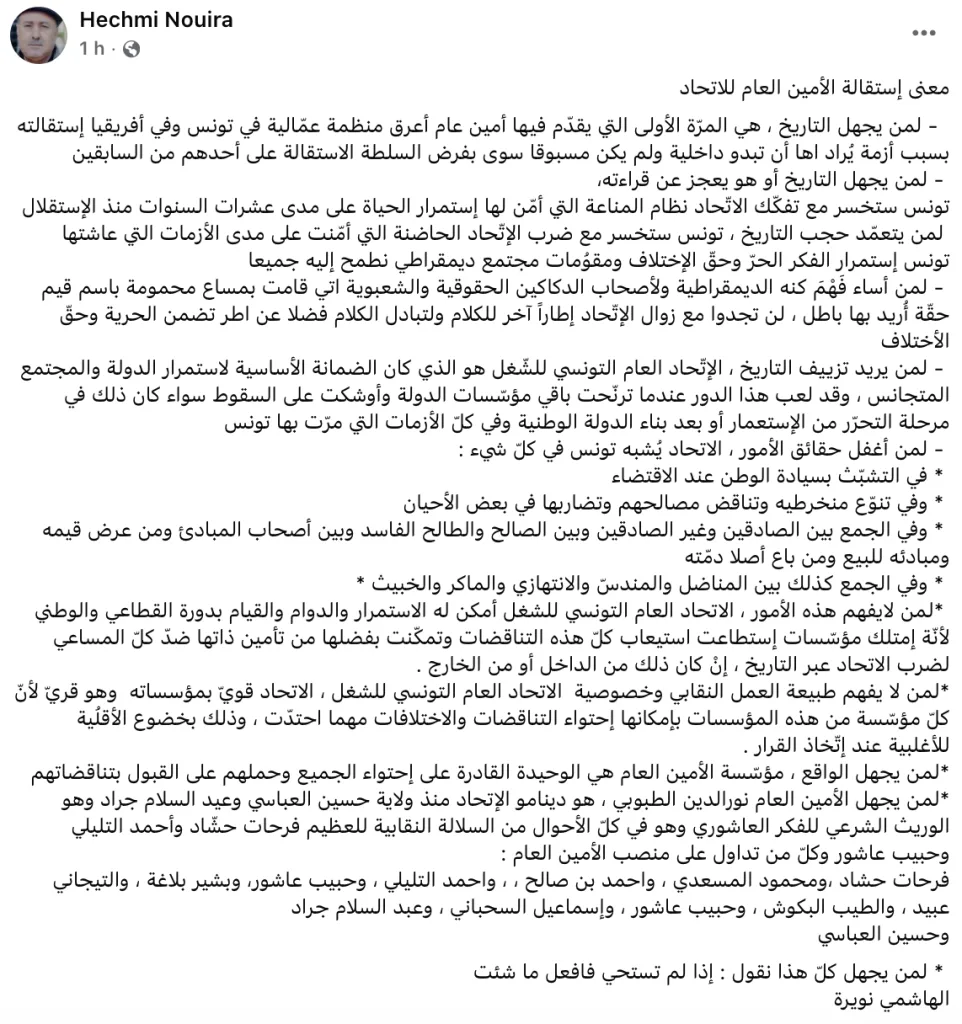
Hachemi Nouira presented a historical and structural reading rejecting any reductive approach to the resignation of Noureddine Taboubi. In particular, he warned of the profound consequences that the weakening of the trade union center would have on national cohesion, recalling the fundamental role of the UGTT as a pillar of the stability of the State, a space of pluralism, and a mechanism for regulating social contradictions since independence.
« For those who are unaware of history, it should be remembered that this is the first time that a secretary general of the oldest and most emblematic workers’ organization in Tunisia, and in Africa, has resigned due to a crisis that we are trying to reduce to a simple internal matter. Until now, the only precedents were resignations imposed by the political authorities on certain of its leaders. To those who are unaware of history, or who are incapable of reading it, we must clearly say this: with a possible dismantling of the Union, Tunisia would lose a real system of collective immunity, one which has guaranteed the continuity of national life for several decades since independence. To those who deliberately seek to obscure history, it must be remembered that the weakening of the UGTT would deprive the country of the protective space which, throughout the crises experienced by Tunisia, has ensured the sustainability of free thought, the right to divergence and the very foundations of a democratic society to which all Tunisians aspire (…) “, he noted.
At this stage, no official position has yet been adopted regarding the acceptance or rejection of this resignation by the executive office of the UGTT, leaving institutional uncertainty with serious consequences.
NJ