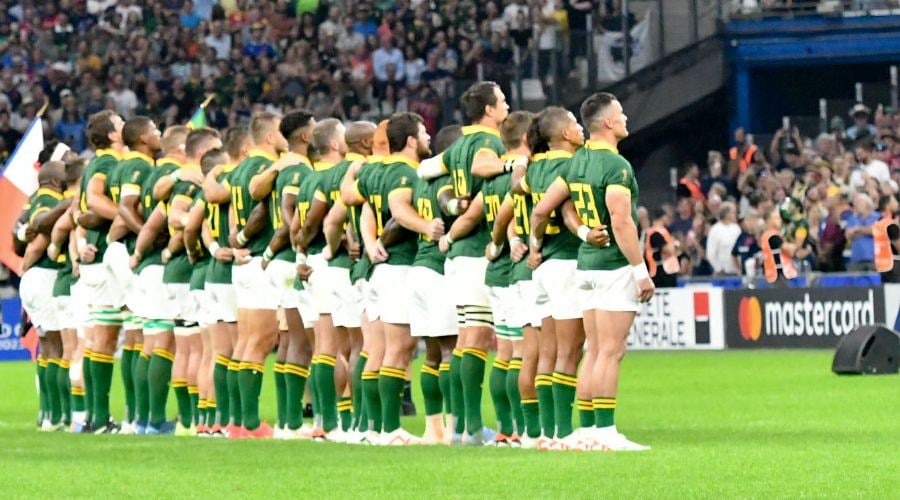

Opponent of the XV of France, Saturday, for its first test of November, South Africa enjoys a sulphurous reputation in terms of doping. The correction inflicted on the Blues in 1997 is a perfect illustration of this.
Winners of their third world crown in 2019, the South African players sparked a real controversy thanks to a single photo taken during preparation and posted on social networks. Johan Erasmus’ players posed in the locker room, a few days before the start of the World Cup, with bulging pectorals, perfectly defined abs and bulging biceps. Enough to trigger strong reactions, with some inevitably seeing the specter of doping.
And the reactions were all the more intense as the 1995 world champions had lost one of them a few days earlier. Chester Williams had in turn died, bringing to four the number of heroes who died before the age of 50. The victory at home by the Springboks on the theme of the reunified nation has caused a lot of ink to flow, between suspicions of doping, poisoning of half of the All-Blacks team before the final and test unfairly refused to Abdelatif Benazzi in the last moments of the semi-final against the Blues.
Two years later, there is little room for doubt. After a first narrow success on the pitch of the Stade Gerland (36-32), South Africa inflicted a real humiliation on the French XV for its farewell to the Parc des Princes (52-10). A defeat which would mark Jean-Claude Skrela’s men with a red iron.
“The South Africans play a different rugby. Their players are increasingly fast, powerful and resistant to tackles. We have the impression that they can put together ten matches in a row of this intensity. You have to prepare yourself physically in order to gain four or five kilos of muscle and gain two or three tenths in speed”observed Philippe Saint-André at the end of the meeting.
In the book Rugby à charges, the shocking investigation by journalist Pierre Ballester, published in 2015, Dr Mombet, then head of the French federation commission, revealed that the Springboks had arrived “with a dozen” of justified prescriptions, the ancestors of the famous authorizations for therapeutic use (AUT). Prescriptions which allowed the players concerned to justify taking a potentially prohibited medication or a specific protocol.
This defeat also highlighted the use of creatine, then considered a miracle product and which was not among the banned substances. The gains are immediate: three to four kilos of muscle in the first weeks and up to eight kilos in the long term.