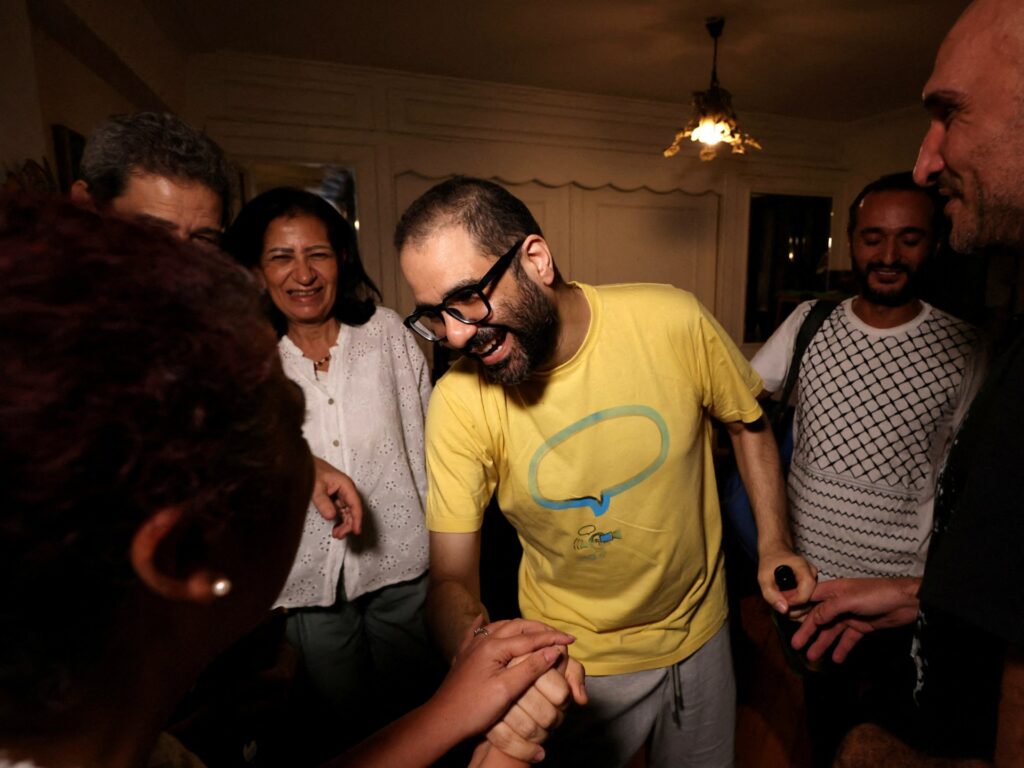
Egyptian-British writer Alaa Abd El-Fattah, who faced years of imprisonment in Egypt, ‘unequivocally’ apologises for the tweets.
Alaa Abd El-Fattah, an Egyptian-British human rights campaigner, has “unequivocally” apologised after right-wing leaders in the United Kingdom dug up decade-old tweets to demand he be stripped of British citizenship.
In a lengthy apology posted online, the writer and blogger – who returned to Britain this week after 12 years of imprisonment in Egypt – said the tweets were “shocking and hurtful”, but added that some had been “completely twisted”.
Recommended Stories
list of 4 itemsend of list
Conservative Party and far-right Reform UK leaders, along with right-wing commentators, took to sympathetic outlets and social media to demand that Abd El-Fattah be stripped of citizenship for the posts dating back to 2010, which included alleged references to killing Zionists and police officers.
The tweets were “expressions of a young man’s anger and frustrations in a time of regional crises”, including the wars on Iraq and Gaza, and a pervasive culture of “online insult battles”, Abd El-Fattah wrote.
Still, “I should have known better”, he said.
“I am shaken that, just as I am being reunited with my family for the first time in 12 years, several historic tweets of mine have been republished and used to question and attack my integrity and values, escalating to calls for the revocation of my citizenship,” he added.
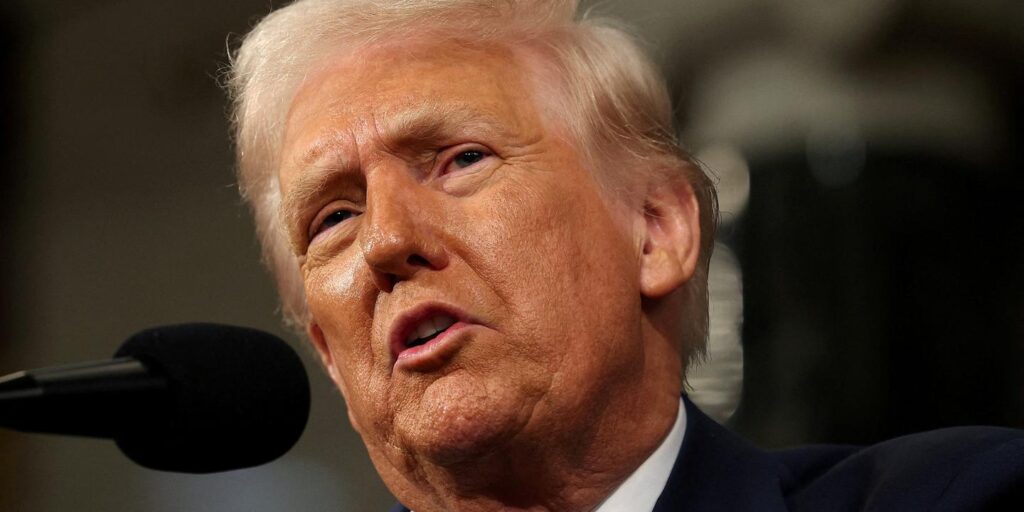
Conservative leader Kemi Badenoch wrote in a Daily Mail op-ed that Home Secretary Shabana Mahmood should consider how Abd El-Fattah “can be removed from Britain” and added that she does “not want people who hate Britain coming to our country”.
Nigel Farage, the Reform UK leader, posted a letter he wrote to Mahmood on X and took a swipe at Badenoch for being part of the 2021 administration, then under Conservative Prime Minister Boris Johnson, that granted Abd El-Fattah citizenship.
Human rights activists and supporters of Abd El-Fattah dismissed the efforts as a smear campaign and directed followers to his apology.
Jewish academic and writer Naomi Klein wrote on social media that right-wingers were “playing politics with his hard-won freedom”, while Mai El-Sadany, executive director of the Washington, DC-based Tahrir Institute for Middle East Policy, said the citizenship revocation campaign was “coordinated” to “impugn his reputation and harm him”.
British law allows the home secretary to revoke citizenship if doing so is considered “conducive to the public good”, a policy that critics say is disproportionately wielded against British Muslims.
In a 2022 reportthe Institute on Statelessness and Inclusion estimated that at least 175 people had been stripped of British citizenship since 2006, including more than 100 in 2017 – prompting the group to deem the UK “a global leader in the race to the bottom” for revocations.
Part of British conservatives’ ire appeared to stem from the reaction of British Prime Minister Keir Starmer to Abd El-Fattah’s release. Earlier this week, he said the case had been a “top priority” and added that he was “delighted” by Abd El-Fattah’s return, a sentiment echoed by Foreign Secretary Yvette Cooper.
Abd El-Fattah had been jailed during Egypt’s mass protests in 2011 that ousted then-leader Hosni Mubarak. He went on to become a top critic of Egyptian President Abdel Fattah el-Sisi, who took power in a military coup two years later.
The writer received a 15-year prison sentence in 2014 on charges of spreading fake news. He was briefly released in 2019 before receiving another five-year sentence.
He received a pardon in September, along with five other prisoners, after repeated international calls to release him.