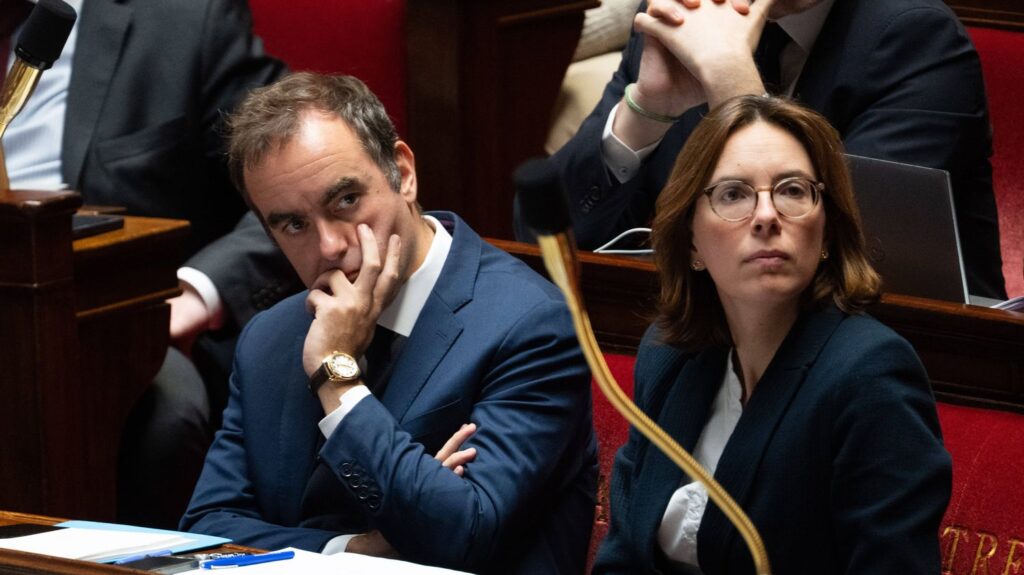
The Constitution sets a duration of forty days for discussions on the finance bill. After this deadline, the government can send the initial copy of the text to the senators, but the Minister of Public Accounts gave assurances to the deputies on Monday.
Published
Reading time: 7min
:quality(50)/2025/11/05/sipa-01237460-000078-690b7d4282a1a771061474.jpg)
The government is continuing its strategy of small steps. Faced with the long debates on the revenue side of the finance bill in the National Assembly, the Minister of Public Accounts, Amélie de Montchalin, announced Monday, November 3 that the government would transmit to the Senate “all amendments” voted, even if time ended up running out to complete the examination of the budget. MEPs have around 2,300 amendments left to consider from November 12 to 17, including the weekend.
The Constitution sets a duration of forty days for discussion on the finance bill. After this deadline, the government can transmit to the Senate the initial copy, purged of all the modifications voted in the hemicycle of the Palais-Bourbon. By promising not to choose this path, Sébastien Lecornu wants to send a mark of respect to the deputies.
In the corridors of the Assembly, the government’s announcement was rather well received on Tuesday. “It’s a sign of openness”greets Harold Huwart (Liot group). “It is very little used in practice”recalls Benjamin Morel, professor of public law and secretary general of the Laboratory of the Republic, chaired by the former Macronist Minister of National Education Jean-Michel Blanquer. The political scientist mentions a precedent: in 2023, the pension reform had not been voted on at first reading in the Assembly and the government of Elisabeth Borne had transmitted a revised version of its initial text, to add its amendments.
“Sébastien Lecornu wants a copy that will be transformed by both chambers”explains an executive advisor. “This makes it possible to respond to those who raise the music of ordinances. If we gave up on 49.3it’s not to go this way”continues this source.
Before the budgetary debates, the Prime Minister declared that he would not use this paragraph of the Constitution, which allows a text to be adopted without a vote, but with the risk of censorship. However, some of the opposition believe that the government will pass orders to have its version of the budget adopted, as the Constitution authorizes, at the end of the seventy-day examination period.
“Sébastien Lecornu makes the necessary concessions”assures a deputy from the Macronist camp. “It’s quite logical and legitimate. Whether we like it or not, the Assembly has spoken clearly,” agrees another elected official from the presidential party. “It is not illogical that the work of deputies is taken into account, even if the deadlines do not allow a vote on the final text.”
On the socialist side, we welcome another concession made to parliamentarians, after the renunciation of 49.3. “It’s a good thing so that everything doesn’t fall”believes an influential PS deputy. “It’s positive, the government is saying: ‘I’m not throwing in the trash what was done by the deputies’”adds a party senator. “It opens up a new field of possibilities. Before, everything that was voted on in the Assembly was crushed by 49.3”greets Mélanie Thomin, spokesperson for the group in the Assembly.
If they failed to pass the Zucman tax, the socialists highlight several victories, from the creation of the tax on unproductive wealth to the non-taxation of compensation for people suffering from long-term illness (ALD). “We have partly succeeded in emptying the museum of horrors”believes Mélanie Thomin.
“It’s likely not to irritate us”smiles an environmentalist deputy. “It’s the least we can do” that the government retains the amendments voted for by the deputies, he adds.
“This is not a gift from them: they are weak, under the threat of permanent censorship. However, they present this to us as if it were a largesse!”
an environmentalist deputyat franceinfo
All the parliamentarians interviewed by franceinfo predict, however, that the senatorial right, in the majority in the Luxembourg Palace, will largely unravel the text, which it must examine from November 26. Jean-François Husson, budget rapporteur in the Senate, described Wednesday as “monstrosities” the measures adopted by the Assembly. “It’s going to be the butchery, we will have a very right-wing copy, Bruno Retailleau (leader of the right in the Senate and boss of the Republicans) will be unleashed”already fears a socialist senator. Enough to put the government’s decision into perspective. “It’s a cheap political gesture”lets go of a Macronist, because “there will be a cleaning in the Senate then in the joint committee”the body responsible for finding a compromise in the event of disagreement between the two chambers.
The government also hopes to avoid a rejection of the first part of the budget in the National Assembly, because, in the event of failure, “the consistent and established practice is that the initial version of the bill is transmitted to the Senatespecifies Benjamin Morel. This choice may encourage MPs not to vote against the text.
“We know that in the Senate the measures taken by the left have little chance of survivingadmits Mélanie Thomin. But they will be debated there, and that’s new.” At the same time, the Prime Minister is increasing consultations with the Socialists and other parliamentary groups. The search for compromise will also come into play during discussions on the Social Security financing bill (PLFSS), which must continue until the vote on November 12.
The text already contains the biggest concession made to the socialists by Sébastien Lecornu: the suspension of the pension reform. The Prime Minister also put on the table the abandonment of the freeze on retirement pensions and social minimums. But the PS, which wants other guarantees, such as the abandonment of the doubling of medical deductibles, continues to brandish the threat of censorship. “If we feel that this debate is beyond our control, we will demand accountability from the government”assures Mélanie Thomin.
If the government’s proposal therefore makes it possible to put a little oil in the wheels of the negotiations, it does not resolve the thorny equation of voting in Parliament. However, no group says it is ready to vote on the budget as it stands. “It’s intelligent from a political point of view, but it’s not certain that it will succeed, confirms Benjamin Morel. We can’t see the landing. It gives socialists a guarantee to perhaps avoid censorship, or legitimize the orders”.
A ludicrous scenario is in fact already mentioned by some: to have a budget adopted containing the concessions made to the PS, and to obtain its non-censorship, the government would ultimately have an interest in using the ordinances… or 49.3. But with the consent of the socialists, this time.