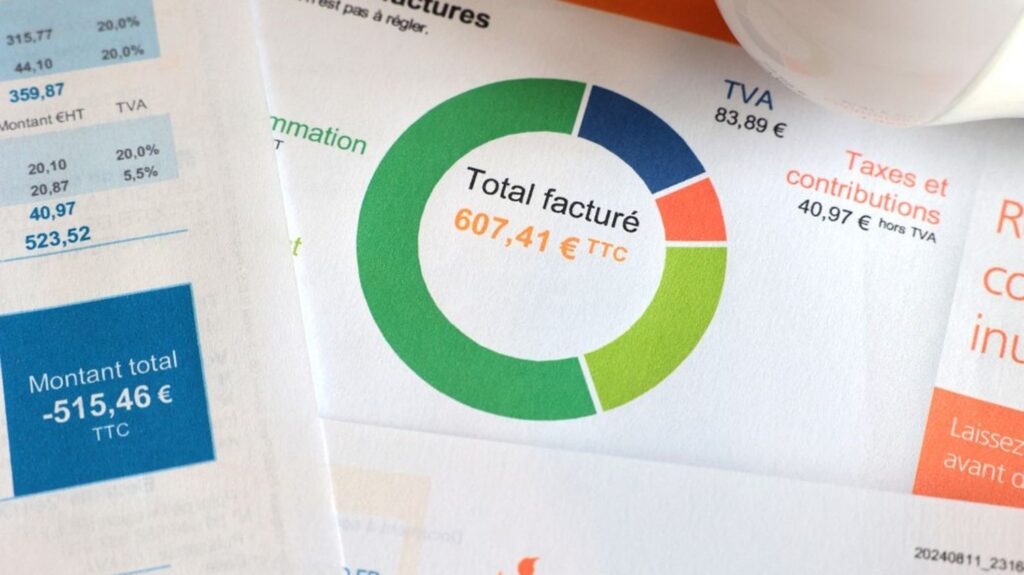
The Arenh system, which required EDF to sell part of its annual nuclear production at an advantageous price, ends on December 31. The change raises fears of a price increase for consumers.

Published
Reading time: 5min
:quality(50)/2025/12/22/080-hl-slapeyrere-2535607-6949102ee93f2559331088.jpg)
Nearly 15 years after its implementation, the Arenh system (regulated access to historic nuclear electricity) ends on December 31. Individuals and industrialists will no longer benefit from this system which required EDF, a 100% public company since 2023, to cede between a third and a quarter of its annual nuclear production to very energy-intensive industries and competing private suppliers at only 42 euros per megawatt hour (MWh). According to published data on his website by the French electricity network manager RTE, MWh prices on the market often exceeded 80 euros on Tuesday December 23.
Planned by a law from 2010Arenh responded to the ambition of the European Union (EU) to liberalize the electricity market to make it competitive, for the benefit of the European economy and customers. “It was a way of allowing consumers to benefit from low nuclear prices, at a time when prices were considered too high”Nicolas Goldberg, energy expert at Colombus Consulting, explains to franceinfo.
However, the market has changed. Since 2011, prices have skyrocketed on wholesale markets and the regulated price has created, according to the EU, a problem of competition with other suppliers. EDF management also saw it as a major obstacle to investment. “The Arenh exposes us without any limit to the lowest sales prices and, in the event of high market prices, requires us to sell our nuclear production at a capped price, which does not cover the costs of the production fleet and which has not been reassessed for inflation for ten years”deplored in February 2021 Jean-Bernard Lévy, then boss of the group, before the Senate Economic Affairs Committee.
The government ultimately decided not to continue the system. From 2026, all EDF electricity will be at wholesale market prices, which vary according to supply and demand. The Arenh will be replaced, in the words of the Ministry of the Economy, by a sort of “guardrail” : the universal nuclear payment (UNV). Described by Bercy as a “compromise between consumer protection” and the needs “investment” of EDF, it must require the energy company to redistribute a part of its excess income to customers if prices are very high.
However, according to the Federal Consumers’ Union-Que Choisir, a surge in prices cannot be ruled out. In February, a study by the association established that the reform would lead to “massive increase” of the cost of electricity, while the redistribution of EDF’s profits would be “very limited”. According to his calculations, an average household would have seen their bill increase by 19% if the reform had been applied in 2025. Nicolas Goldberg, however, puts the hypothesis into perspective: “In 2026, the market share of regulated tariffs will fall, because the year 2023, which had been marked by a surge in electricity prices, will no longer be considered in the regulated tariff of electricity prices (TRVE). Instead, it is the year 2025, marked by a drop in prices, which will be added to the calculation. The end of the Arenh should therefore, in part, be compensated next year.“
Questioned by AFP, the Ministry of the Economy went in the same direction on Monday. Bercy states that “invoice prices should be stable at least in 2026 and 2027”for most French households, “in view of the low prices of French carbon-free energy on the wholesale markets”. For Nicolas Goldberg, however, things look more complicated for professionals, and more particularly industrialists, “who have a larger share of Arenh on their bill”. Instead of benefiting from a prize “fixed and low” all year round, they will now be more exposed to market fluctuations.
The specialist also expresses reservations about the trigger level of the universal nuclear payment, which he considers “too high”. According to Bercy, this system must “reduce consumers’ bills if prices exceed” two progressive thresholds, set at 78 euros per MWh then 110 euros per MWh, “by taking EDF” on revenues that exceed these ceilings. However, according to the Energy Regulatory Commission, it is very likely that consumers will not benefit from this redistribution in 2026, due to the current prices of French electricity on the wholesale markets.